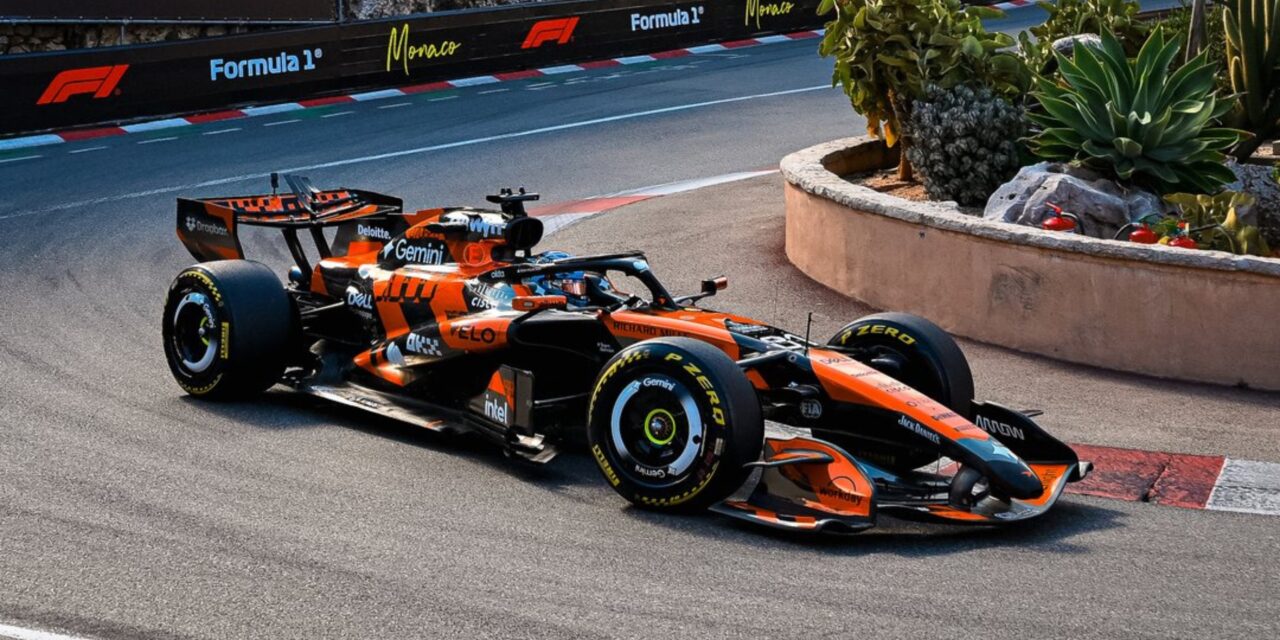
McLaren team principal Andrea Stella has admitted the team received a significant “reality check” during the Canadian and Monaco Grands Prix, as reliability concerns and a lack of outright pace continue to hinder the team’s progress.
After securing a double podium in Miami, many believed McLaren was beginning to repeat the upward trajectory that transformed its fortunes during the 2024 season. However, the momentum generated in Florida has stalled over the last two race weekends.
Lando Norris suffered retirements in both Canada and Monaco due to separate reliability issues, while McLaren also struggled to match the pace of Mercedes and Ferrari around the streets of Monte Carlo.
Monaco and Canada Expose McLaren’s Weaknesses
While McLaren introduced the second phase of its upgrade package in Canada, the improvements have not yet translated into consistent results.
Speaking after the Monaco Grand Prix, Stella admitted both recent races had highlighted areas that require urgent attention.
“There’s certainly an important reality check that comes from Canada and Monaco. And the reality check is, first of all, looking at the facts. We have not been fast enough, I would say especially in terms of race pace. And in both Canada and here, we have not been reliable enough.
“When we look at reliability, we have had issues pretty much in all areas of the car. It’s not like it’s one specific area. Today it was the power unit, and we have had other issues with power unit as well. I would say this has probably been the most important area for reliability, but for Lando in Canada, it was the gearbox.”
Norris lost valuable track time in Monaco after another power unit problem, while Oscar Piastri completed the full weekend but was unable to challenge for the leading positions.
Reliability Problems Continue to Hurt McLaren
According to Stella, the team’s assessment now focuses on both performance and reliability.
The Italian believes the individual issues are understood, but the number of separate failures is becoming a concern.
“So, there’s a performance assessment and there is a reliability assessment that we are doing. Looking at Canada and looking at Monaco, we understand these reliability issues in isolation. We can fix them.
“But obviously, when you have so many issues, it may be symptomatic of the fact that the project is still relatively young.”
McLaren now faces the challenge of working alongside Mercedes High Performance Powertrains to address the recurring reliability concerns while continuing its development programme.
Lack of Downforce Limiting Performance
Beyond reliability, Stella identified a lack of aerodynamic load as one of the key reasons behind McLaren’s struggles in Monaco.
The MCL40 was unable to generate enough grip through the slower sections of the circuit, which also created problems with tyre performance.
“From a performance point of view, I said yesterday already, it’s very clear that we don’t have enough grip, mainly because we don’t have enough aerodynamic load”, Stella continued.
“And it’s also clear that we are not getting the tyres to operate in the window in which they perform at their best, especially at circuits like here and in Canada, where the tarmac is extremely smooth and the tyres operate in a particular regime.”
This issue has become increasingly important under Formula 1’s 2026 regulations, with teams still learning how to maximise performance from the latest generation of Pirelli tyres.
New Tyres Creating Additional Challenges
Stella explained that the tyres themselves are also contributing to McLaren’s difficulties.
Pirelli developed the current tyres using simulation data provided by teams long before the season began. As a result, some teams are finding it difficult to generate the temperatures required for optimal performance.
“This year, the tyres are relatively stiff and they need the temperature to operate well,” Stella admitted.
For teams lacking downforce compared to their rivals, bringing the tyres into their ideal operating window has become increasingly difficult.
McLaren Still Hoping for a 2024-Style Recovery
Despite the challenges, Stella has not given up hope that McLaren can repeat the dramatic recovery it achieved during the 2024 season.
However, he acknowledged the team’s current trajectory is less convincing than it was two years ago.
“So, there’s a long list, performance and reliability. We remain obviously with the mindset that this could be another 2024, in terms of catching up at the end.
“But in 2024, our trajectory from a reliability and performance point of view was more convincing.
“So, if we want to stay in the championship, we need to have a turnaround.”
Barcelona Becomes a Crucial Test
The upcoming Barcelona-Catalunya Grand Prix could provide a clearer picture of where McLaren truly stands.
The Spanish circuit is traditionally viewed as one of the most complete tests on the Formula 1 calendar, exposing both strengths and weaknesses across every aspect of a car’s performance.
For McLaren, it represents an opportunity to prove Miami was not a false dawn.
If the team hopes to remain involved in the championship battle against Mercedes, Ferrari and Red Bull, Stella knows improvements must arrive quickly.
The belief inside Woking remains strong, but after two difficult weekends, McLaren’s hopes of another 2024-style comeback face their biggest challenge yet.