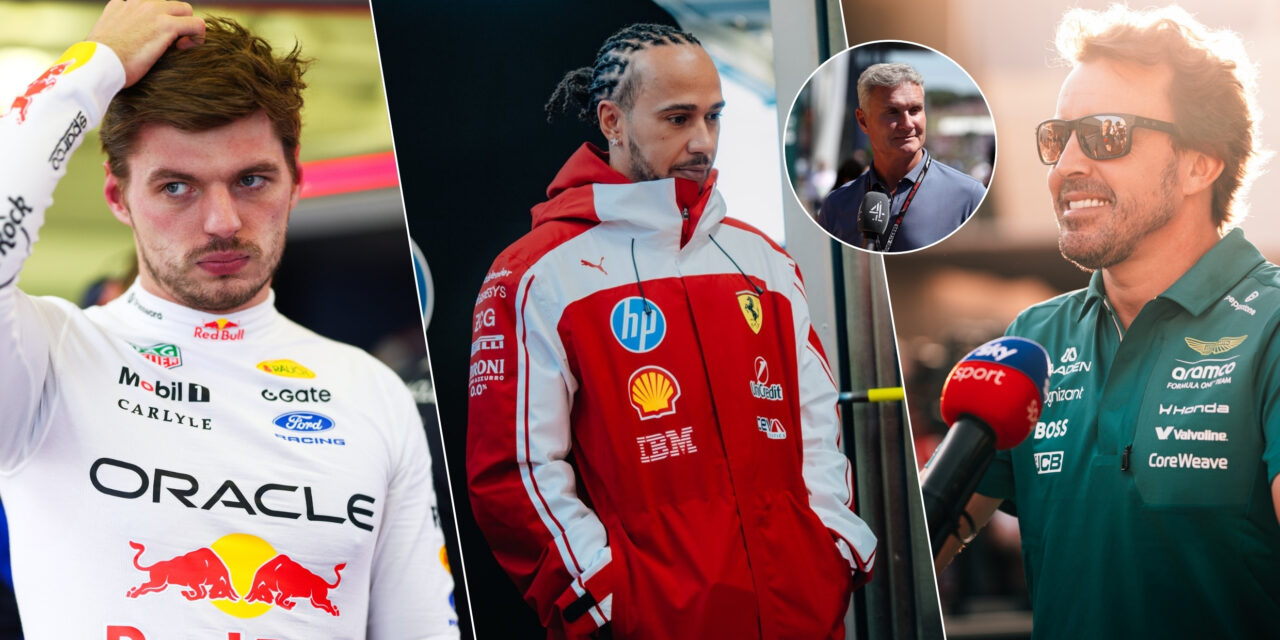
David Coulthard predicts Formula 1’s sweeping 2026 regulation changes could frustrate instinctive champions like Lewis Hamilton, Fernando Alonso and Max Verstappen.
The new rules introduce a near 50-50 split between internal combustion and electric power, smaller and lighter cars, and active aerodynamics replacing DRS. The result is a far more complex driving package, something Coulthard suggests may not sit comfortably with some of the grid’s most naturally gifted racers.
As pre-season testing continues in Bahrain, several drivers have already voiced concerns. Verstappen, in particular, compared the new machinery to “Formula E on steroids”, highlighting the heavy emphasis on energy management.
“They Just Want Pure Racing”
Speaking on the Up To Speed podcast, Coulthard explained why he thinks the sport’s biggest names may struggle to embrace the new era.
“I think, though, all three guys you just mentioned there [Lewis Hamilton, Fernando Alonso and Max Verstappen] during the last hybrid era with the massive ground-effect tunnels that they had, they were all a bit negative about the driving experience,” Coulthard said.
“They just want to be back to pure racing, flat-out racing from start to finish. So with these new regs, there’s a lot more complexity management. 50% of the energy comes from a battery, 50% comes from an internal combustion engine. So, they’re actually becoming a lot more the manager of the car rather than the driver purely of the car.”
According to Coulthard, that shift fundamentally alters the role of the driver.
“And I think that’s where, for them, the issue comes in because as a driver, you want to be driving a car from a point of instinct. You’re driving, you’re trying to get the best out of the car. Now, it feels like they almost have to be mechanical inside making changes, and it just doesn’t come naturally, and it doesn’t really award the best driver.”
His comments echo a growing sentiment that the 2026 cars demand more technical oversight from the cockpit, with drivers juggling deployment strategies, energy harvesting and aero modes in addition to traditional racecraft.
Regulation Changes Bring Opportunity
However, former W Series driver and Sky Sports F1 presenter Naomi Schiff pointed out that major rule resets often reshape the competitive landscape and create opportunities.
“What I will say about regulation changes is that, whilst yes, change always comes with a bit of pushback. And yes, this time around it seems like there’s a lot more push back, and there are probably a lot of things that need to be solved.
“It also comes as a big opportunity. I mean remember 2009 – Brawn came out, smashed it. Then 2014, it became the era where Mercedes dominated. 2022, Red Bull really understood the ground effect era really well. And now the question mark is who’s going to lead here?”
As Formula 1 prepares to enter yet another transformative era, the debate continues: will the added complexity reward the most technically adaptable drivers or will it blunt the edge of the sport’s most instinctive champions?