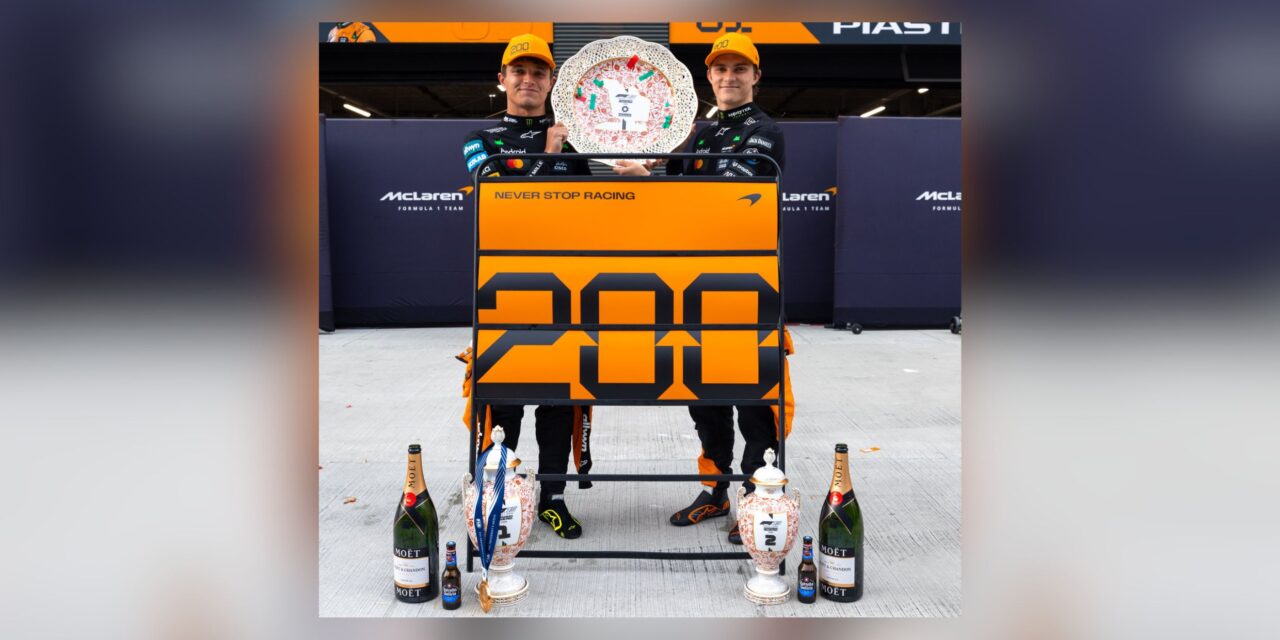
At the 2025 Hungarian Grand Prix, Lando Norris delivered more than just a race victory—he steered McLaren past the remarkable milestone of 200 Formula 1 Grand Prix wins, becoming only the second team ever to cross that threshold, alongside Ferrari.mclaren.com/racing/heritage/mclarens-10-defining-formula-1-victories?utm_source=chatgpt.com" target="_blank" rel="noopener" alt="https://www.mclaren.com/racing/heritage/mclarens-10-defining-formula-1-victories?utm_source=chatgpt.com" class="flex h-4.5 overflow-hidden rounded-xl px-2 text-[9px] font-medium text-token-text-secondary! bg-[#F4F4F4]! dark:bg-[#303030]! transition-colors duration-150 ease-in-out">
Historic Moment: McLaren’s 200th Grand Prix Win
The win unfolded at Budapest’s twisty Hungaroring, where Norris executed a flawless one-stop strategy, fended off teammate Oscar Piastri late into the race (winning by just 0.698 seconds), and closed the retro gap to a team that has won across generations. This marked McLaren’s 13th victory at Hungaroring, an impressive circuit record.
McLaren CEO Zak Brown called the performance “as close to perfect as you can get,” praising flawless pit stops, race strategy, and the drivers’ skill.
A Legacy of Winning: McLaren’s Milestone Moments
McLaren’s first triumph came in 1968 when Bruce McLaren himself drove to victory at the Belgian Grand Prix—laying the foundation for decades of success. Since that breakthrough, many motorsport legends added to the tally: Emerson Fittipaldi, James Hunt, Ayrton Senna, Alain Prost, Mika Häkkinen, and Lewis Hamilton, each winning multiple races in McLaren machinery.
The team claimed its first Drivers’ Championship with Fittipaldi in 1974, followed by Hunt’s title in 1976. The 1980s and early ‘90s marked McLaren’s golden technical era—domination fueled by Ron Dennis’s management and ground-breaking development like the carbon-fiber MP4/1 chassis.
A Win As Historic as It Was Tactical
The Hungarian GP win wasn’t just a number—it encapsulated McLaren’s mix of innovation, bravery, and racecraft. A rare one-two finish, their fourth in a row this season, echoed the Senna–Prost dominance of 1988. The tight margin, bold strategic call, and perfect execution exemplify the traits that have propelled McLaren through F1 history.
Norris’s individual drive—marking his ninth career win and narrowing his championship deficit—also proved his growing maturity and capability as a title contender.
What’s Next: Momentum into the Second Half
Championship implications are profound. With this win, McLaren stretches its Constructors’ Championship lead to 299 points over Ferrari. The drivers’ title fight has tightened—Piastri now leads Norris by just nine points, and Red Bull’s Max Verstappen trails in third, over 90 points back.
Team principal Zak Brown emphasized the need to manage rising internal rivalry. Though competitive, both drivers have handled incidents with respect and maturity—a hallmark he intends to preserve through the high-stakes second half.
With 2026’s regulation changes looming, McLaren’s momentum, stability, and performance at tracks like Hungary suggest they may lead the next technical shift—built on a foundation laid over nearly six decades of strategic innovation and winning heritage.
Final Thoughts: More Than Just a Win
McLaren’s 200th Grand Prix victory is not just a numeric milestone—it’s a celebration of legacy, evolution, and continued excellence in a sport defined by competition and innovation.
From Bruce McLaren’s pioneering first win in 1968, through championship eras, to today’s Norris and Piastri leading the charge—it’s a dynasty built on passion, technology, and teamwork.
As they head into the summer break with momentum and history on their side, McLaren aren’t just marking an anniversary—they’re building the future of Formula 1.