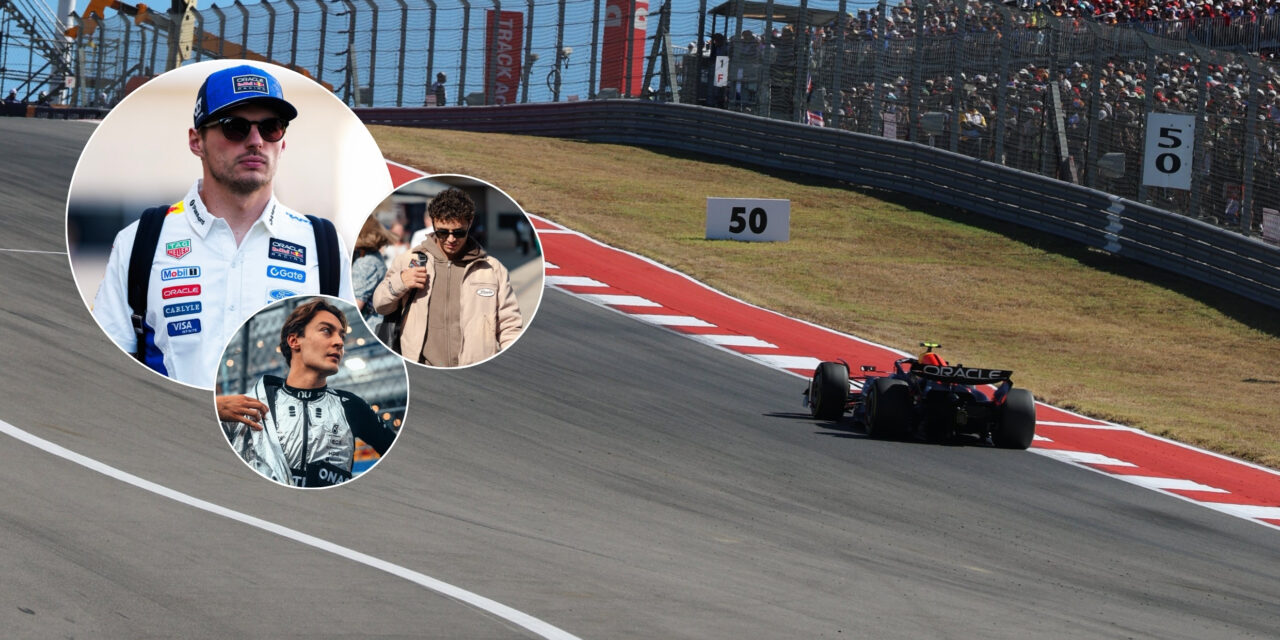
Max Verstappen, Lando Norris and George Russell have raised concerns over the condition of the Circuit of the Americas ahead of the 2026 United States Grand Prix, with the physical impact of the track’s bumps becoming a major talking point in Austin.
Verstappen has delivered the strongest criticism, describing the condition of COTA as “unacceptable” and warning about the long-term impact repeated vertical forces have on Formula 1 drivers.
Norris has backed his rival and revealed he takes headache tablets before driving at some particularly bumpy circuits. Russell also believes F1 needs to consider resurfacing tracks more regularly because modern cars run so close to the ground.
The concerns come despite significant work at COTA in recent years, including a full resurfacing ahead of the 2024 United States Grand Prix and further repairs before the 2026 race.
Verstappen Concerned After Watching WEC at COTA
Verstappen first raised the issue during the Singapore Grand Prix weekend after watching the World Endurance Championship’s Lone Star Le Mans event at COTA in September.
At the time, he joked about what the bumps might do to his body.
“But it’s again a very different track,” he said. “From what I saw in WEC, the track is incredibly bumpy. Oh my God, I probably need to order a new spine after the weekend, or become like Robocop. Crazy.”
By the time Verstappen arrived in Austin, his comments had taken a more serious tone.
The four-time world champion made clear his concerns went beyond driver comfort.
“From what I saw in WEC, it was extremely badly bumpy. I’m not really looking forward to that, to be honest, for your spine,” said Verstappen. “I was joking about that in the last race, but it’s not really a joke to be honest. We mentioned this already for years, that it’s actually getting a bit out of control.”
COTA’s Surface Has Been a Long-Term Problem
The Circuit of the Americas has faced issues with its surface for years.
Part of the problem comes from the ground beneath the circuit. COTA was constructed on high-plasticity clay, which expands and contracts as conditions change.
Movement beneath the asphalt contributes to the uneven surface, with some of the biggest bumps appearing around braking and cornering zones.
Organisers have repeatedly worked on the circuit.
The entire track was resurfaced ahead of the 2024 United States Grand Prix. Further work has taken place ahead of this year’s event, including resurfacing between Turns 9 and 11 and repairs between Turns 12 and 19.
Verstappen believes more substantial work is required.
“It’s very bad. Of course, you can use the excuse that the soil is the problem, but then you should have known that and you need to make sure that you reinforce it more,” the Dutchman said.
“I mean, I love this track, I love this place. It’s one of the best layouts ever and it’s one of the, I would say, best venues and best cities to be at. But for me, the bumps that we have are unacceptable.
“Over time, they’ve been grinding a little bit here and there, but you’re putting a plaster on the big problem and that’s just what’s underneath. That’s what you actually need to tackle in the first place.”
Verstappen Wants a More Permanent Solution
Verstappen believes resurfacing individual areas will struggle to solve the underlying issue.
Instead, he wants the problem beneath the circuit addressed, even if such work would require a major reconstruction project.
“But that, of course, means you need to really fully open up the track,” he added. “That costs a lot of money and time, but honestly, that’s the only way to get rid of it. Because yeah, these bumps are not natural and they are out of control.”
The issue is unlikely to disappear from Formula 1 discussions soon.
COTA has secured its position on the calendar until 2034, meaning F1 expects to continue visiting Austin for years to come.
2026 F1 Cars Could Make Bumps More Painful
The introduction of Formula 1’s new regulations for 2026 has changed how the cars behave, but Verstappen does not believe the latest generation offers much relief around COTA.
He believes the characteristics of the cars could make certain impacts worse, particularly under braking.
“It’s probably worse because we have very low ride heights while cornering,” said Verstappen. “On the straights you have the SM mode, so you go up. But in most places under the braking especially, you actually bottom out more than before. And most of the bumps are under braking or in the corner, not on the actual straight.
“Under braking, it’s like actually a very stressful moment – especially when there are these kind of awkward bumps, not just bumps from the track getting older, but bumps from the surface underneath, the soil just moving up and down. Sometimes it’s very hard to know what to expect, or if you’re a tiny bit offline, you don’t know what is there because no one really drives there. So, yeah, it’s really not nice.”
The unpredictable nature of the bumps creates another problem. Drivers know where many of the biggest surface changes are on the normal racing line, but moving slightly offline might expose them to different impacts.
That becomes particularly relevant during racing when drivers need to move away from the usual line to attack or defend.
Verstappen Reveals 9G Vertical Impact
Verstappen also highlighted the forces drivers have already experienced at COTA.
The Red Bull driver revealed some vertical impacts reached more than 9G during the previous United States Grand Prix.
“Last year, for example, you pull around 5-6G in a corner, but I had some impacts, the vertical load, which was like over 9G on my spine,” he said. “I can tell you that it’s really not fun and especially the older you get, you think about that more and more. That’s not what you want.”
Verstappen has spent more than a decade competing in Formula 1 and believes the physical consequences of driving these cars should receive greater consideration.
“Last year, for example, you pull around 5-6G in a corner, but I had some impacts, the vertical load, which was like over 9G on my spine,” he said. “I can tell you that it’s really not fun and especially the older you get, you think about that more and more. That’s not what you want.”
He also revealed concerns about the condition of his lower spine after years of racing.
“I think sometimes people don’t really understand that. I can tell you from the checks that I’ve done from my spine, the bottom end of the spine doesn’t look that great.
“I know that’s part of racing and I know that can be part of sport, but it’s of course also further damage from the cars that we had the last few years. And now if we continue finding this acceptable to drive on, then you are going to suffer from that much more.
“People can say, yeah, but there are worse sports out there for damage to parts of your body. For sure, but that’s why I’m not doing them. So, yeah, it’s not nice.”
Norris Backs Verstappen Over COTA Concerns
Lando Norris shares many of Verstappen’s concerns.
The McLaren driver pointed towards the tighter standards applied when modern racing circuits are constructed, arguing that COTA’s current surface would struggle to meet those expectations.
“Well, I would say yes. I mean, if you build a new track now the FIA… the rules, the regulation of building a new track, the tolerances you have to be within are pretty small. It certainly doesn’t fit anywhere close to what those regulations are now, let’s say, but it’s an old track, not a new track – it’s pretty bad.”
Norris then revealed how he prepares for some of Formula 1’s bumpiest tracks.
“There’s a lot of places I need to take headache tablets before I go out. Simply because it’s so bumpy and you’re hitting your head pretty hard against the headrests and things because of the bumps, so it’s certainly not a nice thing.
“But there’s not much we can do. I mean we complain about it, so it’s certainly brought up many, many times but there’s only so much we can complain about things, but he’s right. Certainly right.”
His comments add another physical concern to the discussion.
While Verstappen has focused heavily on the forces passing through a driver’s spine, Norris highlighted the repeated movement of a driver’s head against the headrest.
Russell Wants F1 Tracks Resurfaced More Often
George Russell also accepts COTA has a problem, although the Mercedes driver views bumps as part of racing to an extent.
Rather than focusing solely on Austin, Russell believes Formula 1 should look at the condition of older surfaces across its 24-race calendar.
“Yeah, it’s bumpy, but I think it’s just part of racing,” he said. “I’d say my general view is F1 tracks probably need to be repaved every couple of years just to make it a bit more consistent, because we’re going to tracks now where tarmac’s coming up, it’s falling apart, it’s causing more issues than not.
“We’re not an Indy car or an F2 car that run their ride heights reasonably high, our ride height’s 10mm at the end of the straight, a centimetre from the ground, so any tiny bump you really feel it.”
That low ride height means relatively small changes in the surface become significant from inside an F1 cockpit.
Russell also pointed towards Formula 1’s switch to 18-inch wheels as another factor affecting how much drivers feel the surface.
“The side profile of the tyres now since we’ve been at the 18-inch is substantially smaller,” Russell continued. “The circumference of the tyre is the same, the circumference of the rim is far greater, so you’ve lost all of that effective suspension in the tyre, which was a damper, which we kind of don’t have anymore. So, again, not ideal, but not much we can do.”
COTA Faces Fresh Scrutiny During United States GP
The debate leaves the condition of the Circuit of the Americas as one of the major issues heading into the United States Grand Prix weekend.
COTA remains one of the most popular layouts among drivers, something Verstappen made clear despite his criticism. The problem centres on whether repeated resurfacing and local repairs offer enough of a solution to the circuit’s underlying ground movement.
For Verstappen, they do not.
Norris has supported his concerns and revealed the physical steps he takes before driving at particularly bumpy circuits. Russell believes more regular resurfacing across Formula 1 would improve matters, especially with modern cars running so close to the ground.
The subject now extends beyond whether a bumpy circuit creates a difficult driving challenge.
Drivers are increasingly focusing on the physical consequences of repeated impacts and whether those forces remain reasonable in modern Formula 1.
With COTA contracted to host Formula 1 until 2034, finding a longer-term solution could become increasingly important if the surface continues to deteriorate.