
After an unexpected break of four weeks following the cancellation of the Bahrain and Saudi Arabian GPs the F1 World Championship gets underway again in Miami this weekend.
The interval has been far from quiet, with much going on behind the scenes, and several teams undertaking some form of testing. Among those running were Mercedes and McLaren, who conducted a 2027 Pirelli tyre test at the Nurburgring, while Ferrari had a filming day at Monza, and Alpine ran at Silverstone. There was also a lot of track activity with older TPC cars.
In addition everyone has been hard at work back at their respective bases on upgrade packages, taking advantage of the lack of racing activity to squeeze as many new parts as possible through the system and onto their cars before Miami.
Big stories to emerge during the break included confirmation of the return of the Turkish GP in 2027, and the appointment of former Toyota F1 driver and three-times Le Mans winner Allan McNish as the new racing director of Audi. The Scot effectively replaces the departed Jonathan Wheatley, but without the team principal title – which remains with Mattia Binotto.
However the main talking point throughout the last month has been the current state of F1 and ongoing efforts to tweak to regulations in order to improve the racing. A series of meetings culminated in key decisions being taken and announced on April 20, and which will be implemented in Miami.
Analysis: Tweaked PU rules for Miami GP
The FIA’s intention was always to see how the new regulations played out over the first three races before taking a deep dive into their impact, and the break allowed the whole sport to catch its breath and see what can be done better.
The good news is that the key stakeholders were able to agree on a package of measures for Miami. Some had a safety aspect and were therefore mandated by the FIA, and others required a “super majority” vote.
“It was quite clear we need to take certain steps,” says FIA single-seater director Nikolas Tombazis, the man who ultimately oversees the rules. “I think it was quite clear that people also needed to come off the comfort zone for some of these discussions. Some things were going to happen for safety, so people knew that.
“But by and large, I would say people were quite constructive. And I think what was reached was a genuine level of consensus.”
The main safety issue was that of closing speeds, highlighted by the Oliver Bearman accident in Japan, while there have also been efforts to improve qualifying, and make it more of a traditional challenge of driver commitment.
The reality is that while welcome the package is not revolutionary, but it should make for a better show – and happier drivers – in Miami. It remains to be seen if further steps will be taken after a few more races, but the option is there.
“It doesn’t mean that these discussions cannot continue,” says Tombazis. “We are quite certain these changes will be a step in the right direction, and a reasonably significant one. Whether it will be enough, or whether we will need to take an extra step at some point, that is something we’re going to assess over the next few races.
“We are open to continue this discussion. We clearly engage with the teams, with FOM, with the drivers. We also listen to the fans. I think all of that put together is what helps us form our strategy.”
Team focus: Mercedes
Mercedes was the dominant force over the first three races, with George Russell winning in Australia and Kimi Antonelli seizing the championship lead after his successes in China and Japan.
The team got its season off to a flying start under the new rules, and the key now will be whether or not it has been able to maintain that advantage in the light of the upgrades brought by rivals, who have had a full month to dig into the data gleaned in the early races.
Toto Wolff isn’t just looking over the team’s proverbial shoulder – he also has to keep a close eye on how the internal contest unfolds, with Antonelli already giving Russell a hard time at the start of what is only his second season. The Austrian knows how to keep a lid on things.
“The oddity in F1 is that the two teammates are also the biggest competitors, and we have learned a lot over the last 10 plus years in how to best handle these situations,” he says. “But best handle means also letting them race and acknowledging the fact that they race. There are certain values that we stand for in the team.”
Wolff makes it clear where the priorities lie: “The team is always bigger than the drivers. It is Mercedes, so one of the most formidable brands in the world, the best car brand in the world, we race for 150,000 people that work for us, a company that exists for more than 120 years, and having the opportunity to race to be one of the few selected to race for Mercedes also comes with a responsibility for racing for Mercedes.
“And the moment the driver feels like this is all about him, that’s not the mindset that we would ever accept in the team.”
An intriguing aspect is that last year Antonelli landed pole for the Miami sprint event, and thus it was one of his standout venues in the early part of the season. However Russell is not too concerned about his team mate’s form.
“That was his strongest track last year,” says Russell. “But I had 20-plus other tracks that were very strong for me. And the championship is won over the whole season, and as long as I maximize my points by the end of the season, what happens race-by-race, no one remembers.
“And that is my goal. That is what I’m confident in achieving over a course of the championship, consistency, good results on the bad days, victory on the good days. And that is going to continue to be my goal every single weekend. I’m not thinking about Kimi. I’m not thinking about championship – I’m focused on myself.”
Miami GP Preview
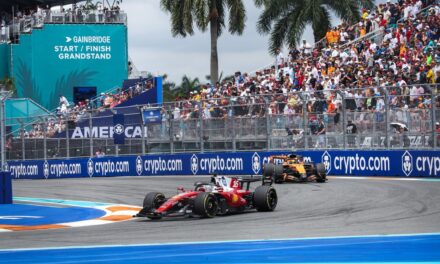
Miami will be the fourth race of the season and thus the fourth circuit at which we’ve seen how the 2026 power unit regulations play out. It’s a track that has a lot of long straights, but also some very tight sections.
Thus far the impact has been slightly different at each venue, and this weekend is really a step into the unknown given the latest changes to the regulations.
In addition as noted earlier all teams will arrive with significant upgrade packages, and it will be fascinating to see how the arms race plays out in terms of the pecking order.
Just to complicate matters Miami is a sprint weekend with limited practice. In recognition of the fact that the rules have changed the FIA has extended the single FP1 session from an hour to 90 minutes, which will help. Nevertheless it’s a big challenge for everyone, and especially new team Cadillac, which has no past data on which to draw.
Miami will be a particularly interesting test or McLaren, winners of the race in 2024 and 2025. The team is bringing the first step of an upgrade package that will see it have what Andrea Stella calls a “completely new car” by Montreal as it tries to close the gap.
Lando Norris, who scored his first win at the venue two years ago, concedes that it’s difficult to know how the rule changes will impact form. However he’s hopeful that we will see some good racing.
“It’s obviously a track that we performed very well at as a team, not just as drivers, over the past couple of years,” he says. “And last year it was one of our best tracks of the season in terms of pace comparing to others. And it’s a different track, and it might still just suit the car a little bit more than some other places. Japan certainly suited the car a little bit more than the first couple races.
“How it will change things, I don’t know. We kind of have to wait and see. You still have a high-speed first sector, and you’re still going to have the very slow-speed middle sector. Because of how the straights are placed and the corners, you could still have actually some pretty good racing in terms of how you can use the battery and save the battery. But if you use it quite often, you know the guy’s going to come back past you the next straight. It could be great – and hopefully it is.”