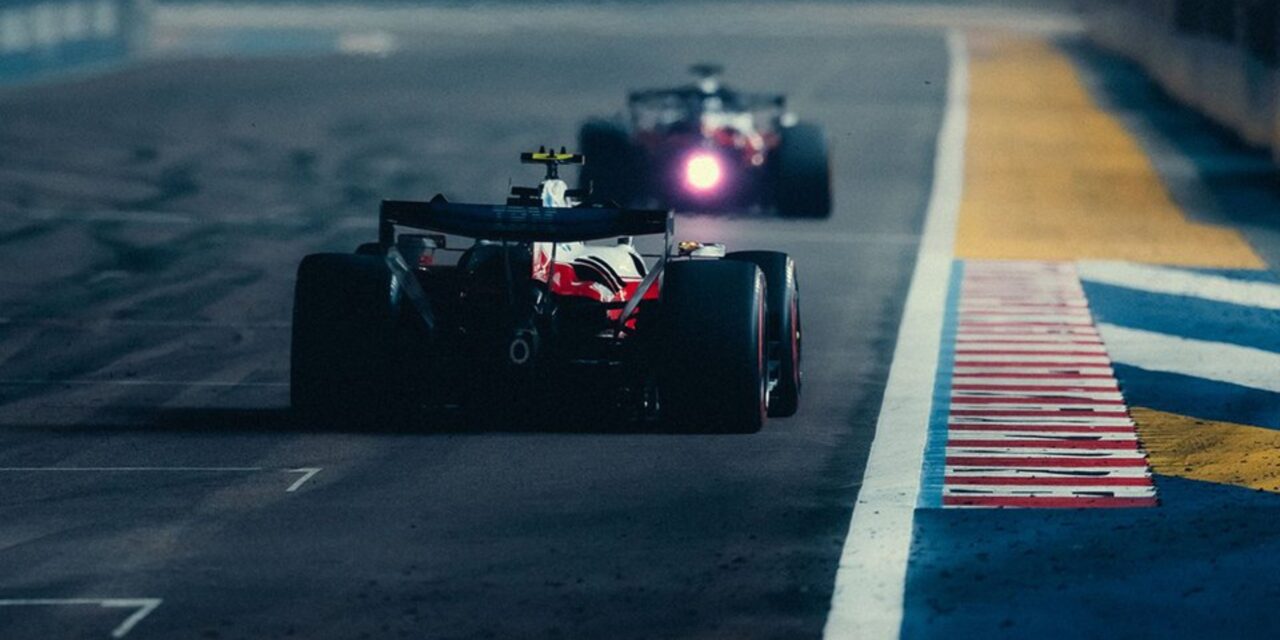
Ferrari is preparing its fourth and most significant aerodynamic upgrade package of the 2026 Formula 1 season for the United States Grand Prix in Austin.
The Circuit of the Americas package will represent Ferrari’s final major development step for the SF-26. Work at Maranello has now largely moved towards its 2027 challenger, with next year’s car set to feature major aerodynamic differences.
Ferrari’s United States Grand Prix upgrades will target several important areas of the SF-26, including the floor, sidepods and upper bodywork.
The team has chosen to develop its existing aerodynamic philosophy rather than follow some of the more substantial concept changes recently introduced by Mercedes and McLaren.
Ferrari Prepares New SF-26 Bodywork for Austin
One of the main areas Ferrari has worked on ahead of the United States Grand Prix is the SF-26’s bodywork.
Unlike some of its closest rivals, Ferrari has decided against a major redesign of its sidepod concept.
Mercedes and McLaren have recently introduced more substantial changes to their respective cars, altering sidepod shapes and how airflow moves towards the rear. Those changes have not immediately produced all the performance expected from windtunnel and CFD work.
Ferrari has instead chosen to maintain the basic architecture already used on the SF-26.
The focus has been on refining its current solutions rather than rebuilding the aerodynamic concept during the closing stages of the championship.
Reducing drag is believed to be one of the main objectives behind Ferrari’s Austin package. The SF-26 has continued to lose performance in this area, with its power unit also lacking some of the output available from rival manufacturers.
Ferrari therefore wants to extract more performance from its existing concept without committing significant resources to a redesign with relatively few races remaining.
Cooling Changes Included in Ferrari Upgrade
The revised bodywork will also feature changes to the SF-26’s cooling louvres.
Ferrari needs to adjust how hot air exits the car following the modifications made to the sidepod geometry.
Further cooling changes are expected one race later at the Mexican Grand Prix. Mexico City’s high altitude places different demands on cooling, meaning Ferrari is expected to run larger openings there.
The Austin specification therefore forms part of a wider approach where Ferrari will combine its final major aerodynamic upgrade with smaller circuit-specific configurations during the remaining rounds.
Ferrari Studied Red Bull’s Sidepod Solution
Ferrari explored several different bodywork concepts during its windtunnel programme before settling on its United States Grand Prix package.
One design studied by the team was Red Bull’s approach with the RB22.
Red Bull has found a way to use the structural stay connecting the floor and bodywork for aerodynamic purposes. Audi has also adopted a similar approach since the Azerbaijan Grand Prix.
Red Bull’s interpretation uses the connection between the stay and sidepod surfaces to produce an aggressive geometry within the regulations. The design helps form channels which direct airflow towards the rear of the car.
Ferrari evaluated whether to introduce a similar idea on the SF-26.
The team ultimately decided against committing substantial resources to the change.
Introducing such a different sidepod philosophy would have required Ferrari to redesign other connected aerodynamic areas, particularly the floor. With limited races remaining in 2026, the potential performance gain did not justify the required development work.
Ferrari Focuses Resources on New Floor
Instead, Ferrari has concentrated much of its Austin development effort on the floor.
This area represents the most significant part of the United States Grand Prix upgrade package.
The changes extend across the floor rather than targeting one isolated section. Ferrari has worked from the front portion of the floor through to the diffuser as it searches for greater aerodynamic performance.
The decision follows the results of Ferrari’s previous major package, introduced at Zandvoort.
Ferrari continued studying the floor after struggling to identify other areas where substantial short-term gains were available. Engineers therefore focused on refining the floor geometry and preparing a larger development step for Austin.
New Ferrari Floor Targets Downforce and Balance
The SF-26 has shown a competitive underlying platform during the 2026 season, but Ferrari has continued searching for more performance from underneath the car.
Increasing downforce forms one part of the objective.
Ferrari also wants to improve the SF-26’s aerodynamic balance. The current car remains too heavily biased towards the front in some conditions, limiting the setup options available to Charles Leclerc and Lewis Hamilton.
Another target is a wider operating window.
Red Bull has made progress in this area during recent races, with the RB22 becoming increasingly competitive across different circuits and conditions.
Ferrari wants its new floor to provide similar benefits by making the SF-26 more consistent across a wider range of setups and track characteristics.
United States GP Upgrade Marks End of Major SF-26 Development
Austin will mark the end of Ferrari’s significant aerodynamic development programme for the SF-26.
Following the United States Grand Prix, any further changes are expected to focus mainly on adapting the car to individual circuits rather than introducing another large performance package.
Ferrari has already shifted much of its development attention towards 2027.
The team has also used its recent windtunnel work to investigate concepts which might feature on next year’s car. Ferrari expects the 2027 challenger to adopt substantially different aerodynamic solutions compared with the SF-26.
Some areas will retain greater continuity.
The chassis has been viewed as one of the strongest parts of Ferrari’s 2026 design, giving the team a solid foundation for its next project. Development of Ferrari’s 2027 power unit is also continuing alongside the aerodynamic programme.
Important Test for Ferrari at COTA
The United States Grand Prix will now provide Ferrari with an important opportunity to see whether its development work translates successfully from simulation and windtunnel testing to the circuit.
Ferrari enters Austin following a strong Singapore Grand Prix, where Leclerc finished second behind Max Verstappen and Hamilton took sixth.
The Scuderia will hope its latest upgrades move the SF-26 closer to Red Bull and Mercedes as the final part of the 2026 season begins.
With changes to the floor, sidepods, bodywork and cooling configuration, Austin represents Ferrari’s final major attempt to extract more performance from the SF-26 before its development resources turn fully towards 2027.