
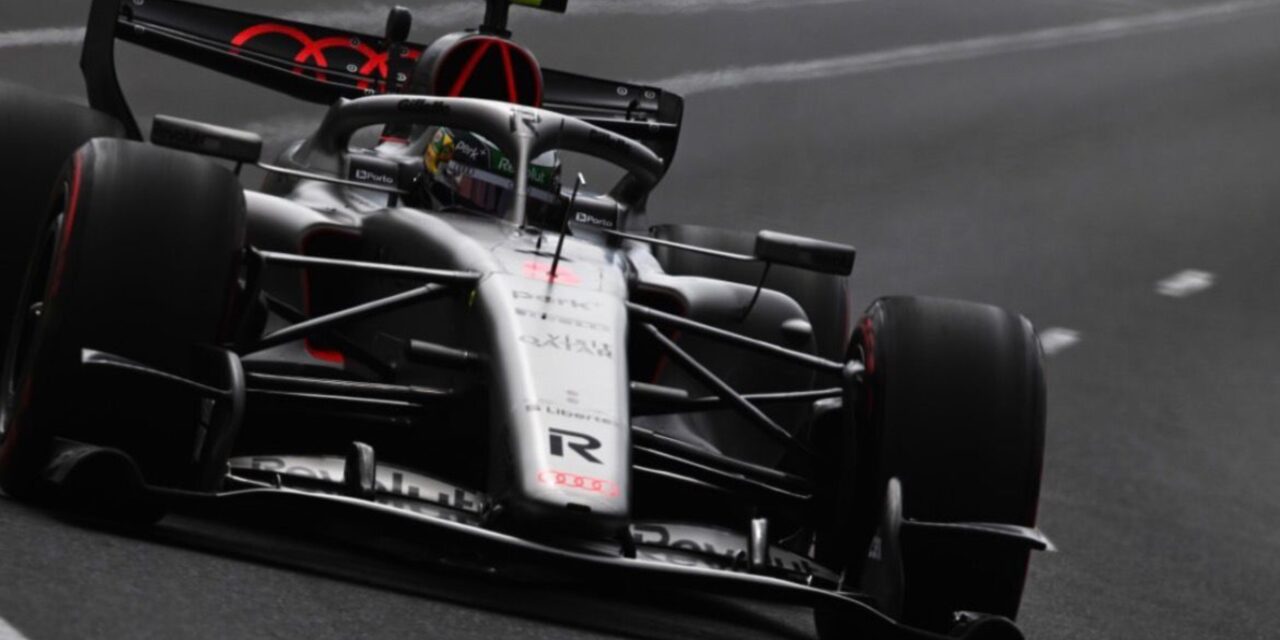
Audi secured points on its Formula 1 debut at the Australian Grand Prix, but the team has acknowledged that its hybrid power unit still requires significant development.
The German manufacturer made its long awaited F1 entry in Melbourne after taking full control of the former Sauber operation. Gabriel Bortoleto delivered a solid result for the new team, finishing ninth and scoring points in Audi’s first race in the championship.
Despite the encouraging result, the weekend also highlighted several weaknesses in Audi’s new powertrain, which was designed and built in house at its upgraded Neuburg facility. Nico Hulkenberg was unable to start the race due to technical issues, while Bortoleto’s qualifying session ended prematurely in Q3 after mechanical problems forced him back to the garage.
The team had already faced early challenges with the engine during its Barcelona shakedown, though several of those issues were addressed ahead of the official pre season tests.
Bortoleto admitted that Audi’s power unit still lacks performance compared with more established manufacturers, but he remains confident the team will close the gap in the coming seasons.
“I have no doubt,” he said when asked if Audi can improve its V6 engine. “I can’t tell you when we’re gonna be there, but I can tell you that we’re gonna be there. If it’s this year, if it’s next year, I don’t know, but I have full confidence that we’re gonna be one of the top engine manufacturers in the future.
“We understand the reasons why we miss [power], and it’s just about working and learning things. There are teams doing this for 15 years, and we are in the first year of building an engine, so it’s not easy.”
Audi team principal Jonathan Wheatley, who previously worked as Red Bull’s sporting director during its dominant years with Honda, believes the new generation of hybrid engines will evolve rapidly over the coming seasons.
He explained that the current cars represent only the early stage of a long development cycle under Formula 1’s latest regulations.
“If you look at all the teams, we’re at the very early stages of this set of technical regulations, which is the biggest change in technical regulations in my time in this sport – perhaps ever.
“The sophistication of the cars at Race 1 [of 2026] is going to be very different to Race 1 in 2030, or 2027, 2028, 2029. As the cars get more sophisticated, the engines become more efficient and the racing becomes closer.
“I think we’re just at the early set of these regulations, and it’s just a case of developing our cars all the way through it, including the power unit.”
Formula 1’s 2026 engine rules were specifically designed to help new or struggling manufacturers close the gap. Under the Additional Development and Upgrade Opportunities system, each power unit is evaluated every six races during the season.
Manufacturers whose internal combustion engines are between two and four percent behind the benchmark receive an extra development upgrade, while those trailing by more than four percent are allowed two additional upgrades.
The sixth race of the season is currently scheduled to take place in Miami on 3 May, although the calendar could still change depending on geopolitical developments affecting upcoming Middle Eastern rounds.
Any disruption to the race schedule could complicate Audi’s development timeline under the current system.
“At the moment, those two races are happening, and that’s our focus,” Wheatley said. “After each batch of six races, the ADUO is revisited by the FIA. It’s a little too early to say at the moment.
“It’s fascinating to see the way the cars are using their energy around the lap, trying to overtake. Gabby commented post-race that it was exhausting, not just physically but mentally, because of how you use the power and how you recover.
“I think we’re a little way away from really understanding if that’s something that we’ll be able to take advantage of.”