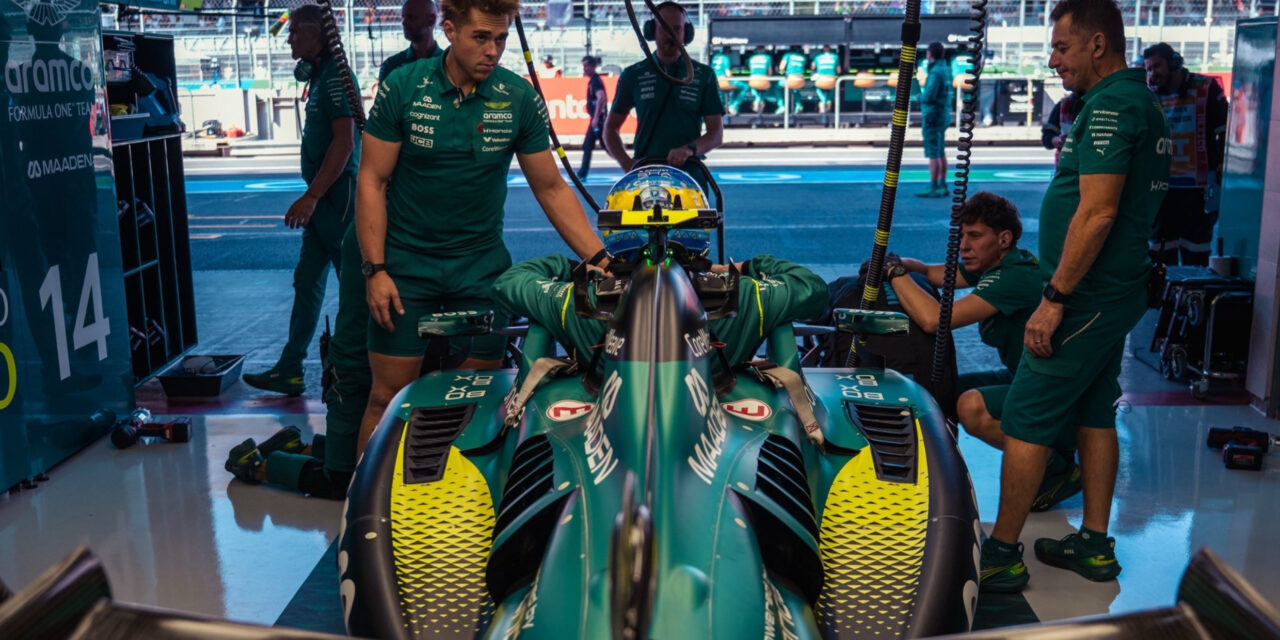
Honda has explained the cooling problems which forced Fernando Alonso and Lance Stroll to retire from the Mexico Grand Prix after only five laps, bringing a difficult weekend for Aston Martin to an early end.
The high altitude at the Autodromo Hermanos Rodriguez was always expected to place additional demands on the 2026 power units. Honda’s Shintaro Orihara had described Mexico as “a very challenging track for the power unit” before the weekend.
Those concerns became a major problem once the competitive sessions began.
Aston Martin had shown reasonable performance and strong reliability during practice. Alonso finished FP2 only 0.769 seconds behind Charles Leclerc, while the two AMR26s completed 144 laps across the three practice sessions.
Honda also made progress with its driveability and turbo lag problems between FP3 and qualifying.
Despite those improvements, Alonso encountered “abnormal signals on the water systems” during qualifying. He still managed to outqualify team-mate Stroll, but both Aston Martins were eliminated in Q1 after finishing around four tenths away from the Q2 cut-off.
The situation became worse during Sunday’s race, with both cars retiring after only five laps because of cooling problems.
Honda Explains Mexico Cooling Problems
Honda trackside general manager and chief engineer Orihara admitted the demands placed on the energy recovery system were greater than expected.
“We knew that with the special high-altitude circumstance of Mexico City, we would face some additional challenges compared to other racetracks for the cooling,” said Orihara, Honda’s trackside general manager and chief engineer, following the race.
“However, we found that our ERS cooling circuit was under heavier stress than anticipated and this is why we had to stop the car in different sessions.
“Despite completing a series of laps during the practice sessions, the issue occurred today and during qualifying yesterday.
“At each race this year, we need to learn for 2027, even the hard lessons. We have a lot of data that we can bring back to this circuit next year, including on the turbo lag, and we will work on the solutions.”
Mexico presented a different technical challenge under the new power unit regulations.
The previous generation of F1 engines featured the MGU-H, which provided support to the turbo and helped reduce lag.
The 2026 power units no longer use the MGU-H, making turbo response a greater concern in the thinner air found at Mexico City’s high altitude.
Honda had already identified turbo lag as one of its biggest areas of focus before the weekend. The manufacturer made improvements before qualifying, but the cooling problems ultimately became the bigger concern.
Alonso Believes Aston Martin Had Performance
The double retirement was particularly frustrating because Aston Martin felt the AMR26 had enough performance to produce a competitive result.
Stroll gave brief answers following the race, while Alonso focused on the reliability limitations which prevented Aston Martin from showing the full potential of its car.
“The car is very good,” the Spaniard said. “The problem is just, we cannot do more laps than a certain number, apparently, with the engine. Hopefully we learned a lesson and we come next year more prepared.”
Alonso had little opportunity to demonstrate his race pace after stopping on lap three before eventually retiring.
His fastest sectors from the limited running suggested the AMR26 had reasonable underlying speed. Putting Alonso’s quickest three sectors together placed him close to the pace shown by Williams driver Carlos Sainz, despite Alonso carrying close to a full race fuel load during his limited running.
Aston Martin chief trackside officer Mike Krack said the team had identified areas where its car should perform well before the weekend began.
“On Thursday, when we sat together, we said this is a track that has a lot of low-speed corners,” Aston Martin chief trackside officer Mike Krack said. “And if we get the driveability under control, that we can be competitive. For example, corners like the stadium section, [Turns] 4-5-6, low-speed stuff.”
Instead of performance becoming Aston Martin’s biggest limitation, reliability prevented the team from taking advantage.
Aston Martin Faces Another Reliability Setback
Mexico continued a frustrating run for Aston Martin during its first season working with Honda under the new power unit regulations.
The team endured a difficult beginning to 2026 before making progress through upgrades and its ADUO development.
Recent races have produced another problem, with reliability starting to affect Aston Martin’s ability to turn its improved performance into results.
Krack admitted the repeated setbacks have made the season difficult for everyone involved.
“It’s difficult for everyone to keep the motivation high in such situations, and we are struggling all year already,” Krack admitted.
“We had a very difficult start of the year, then the period when we introduced the upgrades and the ADUO, we [had] a bit better results. Now, we have more trouble in terms of reliability. In Texas, we had different issues with incidents. You know, it’s part of racing.
“The thing is, everybody tries his best, everybody is motivated to do better, and I have no doubt about the motivation. We don’t have to motivate them, it’s motivating them the highest possible.”
Aston Martin and Honda now have another significant amount of data to study before returning to Mexico in 2027.
The AMR26 showed enough underlying performance to leave the team believing points were possible. Instead, cooling problems prevented either driver from completing more than five laps.
Alonso, though, insists his own motivation remains unchanged despite suffering his seventh retirement of the season.
“I’m doing my best every time, every lap I do, every morning I wake up, every preparation I do, every food I take – everything is focused on performing at my best behind the wheel,” he insisted again despite his seventh retirement of the season.
For Aston Martin, the challenge now is turning the potential of its Adrian Newey-designed car into reliable race weekends.
Mexico showed the AMR26 has performance in the right conditions, but Honda’s cooling and turbo challenges left the team unable to use it when the points were available.