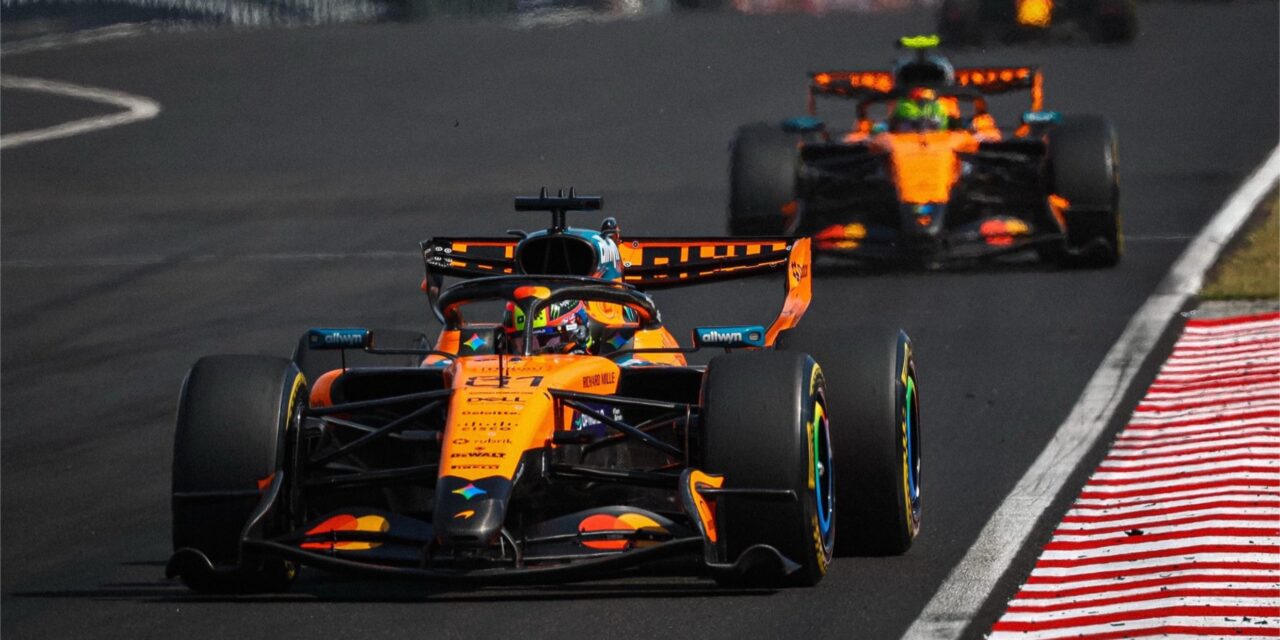
McLaren has admitted Ferrari’s impressive development rate during the first half of the 2026 Formula 1 season has prompted the team to examine how it produces and delivers upgrades.
Formula 1’s new regulations have sparked an intense development battle across the grid, with teams working to extract performance from a new generation of cars.
Ferrari and Red Bull have stood out for the volume of upgrades introduced during the opening half of the campaign.
Those developments have helped close the gap to Mercedes, which initially established itself as the dominant force under the new regulations.
Ferrari and McLaren have now both taken race victories away from Mercedes, and the development battle looks set to continue when Formula 1 returns from its summer break.
McLaren Impressed by Ferrari Upgrade Programme
McLaren has introduced several successful updates of its own, but Ferrari’s ability to produce new parts at such a rapid rate has caught the attention of the Woking operation.
McLaren engineering technical director Neil Houldey believes his team has made good progress but accepts Ferrari has set an impressive standard.
“I think we’ve done a pretty good job of bringing a lot of upgrades that have added performance to the car,” said Houldey. “But when you look around at our competitors, there are teams [like] Ferrari, who’ve done a fantastic job this year to just drive that development forward.”
McLaren is now examining Ferrari’s development rate to understand where improvements might be made within its own operation.
McLaren Looking at Ferrari’s Development Processes
Formula 1’s cost cap places restrictions on how teams allocate resources throughout a season.
When asked whether Ferrari had potentially front-loaded its development spending, leaving McLaren with greater scope to introduce upgrades later in the campaign, Houldey pointed towards the sheer volume of new parts produced by Ferrari.
“Well, I think we’ve been front-loading what we’ve got available.
“I’d say from a volume stand it does look like Ferrari have managed to do a lot, and it’s something for us to look at and understand how they were able to achieve that. Because you look at that from an aerodynamic development point of view, you look at it from a manufacturing point of view.
“Actually, how they turned around this stuff so quickly, it’s an inspiration for us to look at and say: ‘Come on, we did well in 2024. We did well in 2025. But actually, how do we do even better in 2026 and moving forward into 2027?
“These things, as with anything in F1, if you’re not moving forward and finding ways of doing things faster and more effectively, then you’re effectively going backwards yourself. So, I think it was a good lesson for us to see what other people are capable of and how we do that.”
McLaren Preparing More Upgrades After Summer Break
McLaren’s development programme is far from finished.
The team has further improvements planned for the Dutch Grand Prix at Zandvoort in August, while Mercedes is also expected to introduce additional developments during the second half of the season.
For McLaren, continuing to improve its current car is important for both the remainder of 2026 and its preparations for 2027.
Houldey confirmed the team intends to continue introducing significant parts over the coming races.
“We expect the next few races to be bringing some major parts, and we expect to do that quite late on into the season as well,” he revealed. “We’re certainly not stopping development on 2026 because we know that whatever we take from 2026 into 2027, that learning will carry over.
“Even if our car might get a little bit longer, even if conceptually the suspension might change, everything that we’re learning this year is very much relevant for next year. So, we’re very keen to keep developing the car for as long as we possibly can.”
McLaren Sees 2026 Development as Key to 2027
McLaren does not view continued work on its 2026 challenger as taking resources away from next season.
Instead, the team believes lessons learned from its current development programme will remain relevant despite planned changes to areas including wheelbase and suspension geometry.
That gives McLaren an incentive to continue pushing upgrades deep into the second half of the season.
Ferrari’s progress has also provided another benchmark for the Woking team.
After McLaren enjoyed successful development programmes in 2024 and 2025, Ferrari’s ability to rapidly produce effective upgrades in 2026 has shown where further gains in aerodynamic development and manufacturing speed might exist.
With Ferrari, McLaren, Red Bull and Mercedes now fighting at the front, the rate of development after the summer break could play an important role in deciding how the second half of the 2026 Formula 1 season unfolds.