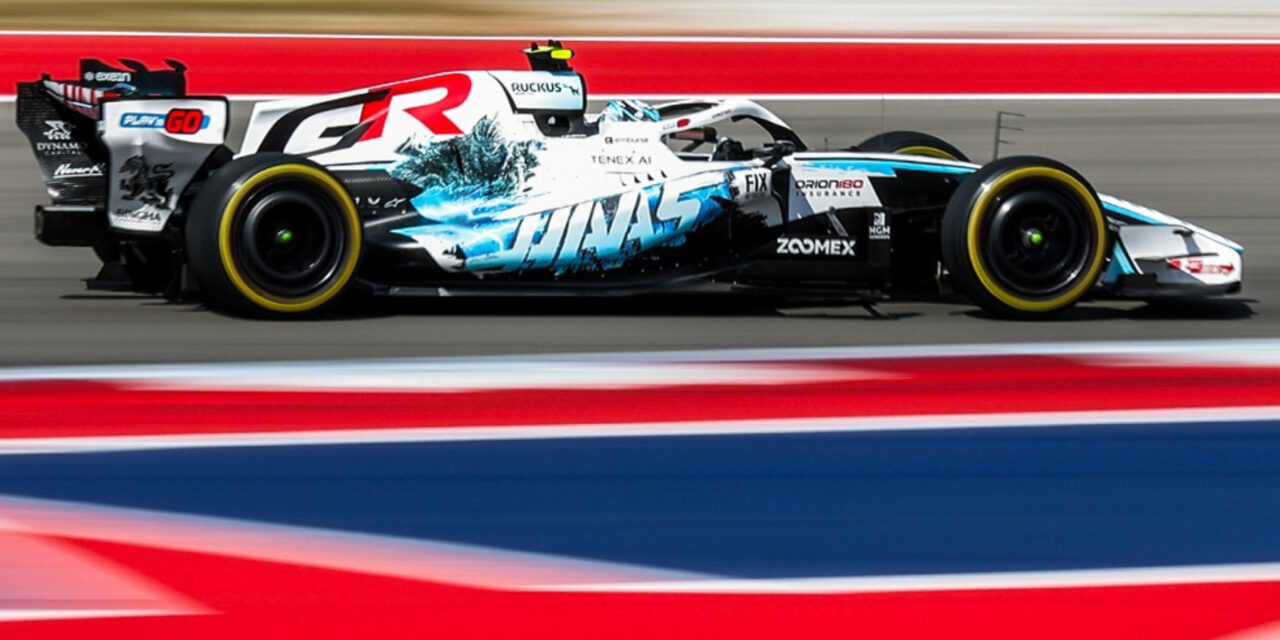
Oliver Bearman believes Haas has reached the performance limit of its 2026 Formula 1 car, with a lack of downforce now holding the team back against its rivals.
The British driver left the United States Grand Prix encouraged by the balance and characteristics of the VF-26, but believes Haas has little performance left to extract from its current package.
Bearman showed promising pace during Friday practice at the Circuit of the Americas. He finished 11th in FP1 before moving into the top 10 in FP2.
His position then slipped as the weekend progressed, eventually leaving him 16th in qualifying.
Bearman believes Haas found a strong setup almost immediately, while rival teams gained more performance from their cars throughout practice.
Bearman Says Haas Maximised Setup Early
Rather than struggling to find a suitable balance, Bearman believes Haas experienced the opposite problem.
The VF-26 felt strong almost immediately, leaving the team with few major setup changes to make.
“It shows that we’re doing a good job as a team,” he said. “We’re getting the most out of our car from FP1, basically. We had a car that we really changed the ride height, I tell you, by one millimetre the whole weekend. From where I started to where I raced the car? Same car.
“Because it was good. Because it was great. From the first time I put the soft tyre in FP1, in my FP1 debrief, I was like, ‘I don’t know what else I need from the car’. It’s very, very good. I mean, the balance is good, it’s feeling good. We just don’t have enough downforce. So it feels good, but we’re just not quite as quick as others.”
Bearman’s comments highlight Haas’ central problem.
The car behaves in a predictable way and gives the driver confidence, but its aerodynamic performance falls short of the cars around it.
Rivals Pull Away as Haas Development Slows
Haas has also faced a development disadvantage during the closing stages of the season.
Its last substantial upgrade package arrived at the Italian Grand Prix, almost two months before the Austin weekend.
Since then, the team has not introduced another significant performance package. Its only notable new component was a rear impact structure designed around the requirements of Sepang.
Several rival teams have continued bringing developments, allowing them to find additional lap time while Haas has remained closer to the performance level established earlier in the season.
Bearman believes this explains why Haas looked stronger at the beginning of the Austin weekend before falling backwards.
“I’m not surprised that we kept the same relative gap to the leaders and everybody else just managed to improve and overtake us,” Bearman continued. “It means that we have a kind of predictable, benign car. The characteristics are very good, but we simply don’t have enough downforce, and it’s very clear: as the lap goes on, even in qualifying, the competitiveness gets worse because we just kill the tyres and we can’t hold on to them.
“It’s frustrating, but at the same time, what else can we expect? Our competitors brought upgrades again this weekend. I mean, they brought like three or four times more upgrades than we have. So I’m not surprised that we’re getting outdone by all of them, they have faster cars than us.
“That’s why I don’t really regret the decision to go for it on Pierre. Because I know that if that doesn’t happen, I’m just going to follow him around and eventually get overtaken probably by the Audis, and that’s not what I’m here to do. I need to score points and that’s what we need to do as a team. Yeah, we need a faster car at the end.”
Lack of Downforce Hurting Haas Tyre Performance
Bearman’s explanation also points towards a connection between Haas’ aerodynamic deficit and its tyre management.
As a qualifying lap progresses, the VF-26 struggles to maintain its competitiveness.
Without enough aerodynamic load, the car asks more from its tyres through the corners. Bearman believes this contributes to the tyres losing performance as the lap develops.
The result leaves Haas in a difficult position.
Improving the setup offers limited gains because Bearman already feels comfortable with the car’s balance. The bigger problem requires additional aerodynamic performance.
With no major upgrades arriving, Haas has fewer options available to address the weakness during the final races.
Bearman Says VF-26 Has Reached Its Limit
Asked whether Haas still had more performance available from the current car, Bearman’s answer was clear.
“Unfortunately not,” Bearman said. “No, it’s hit the ceiling.
“If I was just driving around by myself, I would be like, ‘Ah, the car feels very nice’. If I compare it to how it felt maybe three or four events ago, the characteristics have improved a lot. However, load is load, downforce is downforce, and we lack it.”
His assessment suggests Haas has made genuine progress with the behaviour of the VF-26.
The car’s characteristics have improved compared with earlier races, giving Bearman a more predictable platform.
That progress has not solved the underlying performance deficit.
Without greater downforce, Bearman believes there is little more Haas will extract through setup changes alone.
Ocon Reports Different Haas Problem
Esteban Ocon offered a less positive assessment of the VF-26 following the United States Grand Prix.
While Bearman praised the car’s predictable characteristics, Ocon struggled with braking consistency when pushing towards the limit.
The Frenchman believes the problem becomes particularly noticeable during qualifying and when tyre performance starts dropping.
“It comes in quali when you push the car to its limits,” Ocon detailed. “And when the tyre takes off, I need to anticipate braking 10-15 metres and I still do pick up a lot of locking and a lot of understeer. It’s not a very nice feeling, it’s quite unpredictable. It’s been there all weekend, so we minimised it, which I think was quite positive; with the engineers we managed to get it a little bit more under control, but the underlying problem is still there.”
Ocon eventually finished 14th in Austin, crossing the line 34 seconds away from the points.
His comments show Haas still has areas to address beyond the outright downforce deficit identified by Bearman.
Haas Faces Difficult Final Races With VF-26
Haas now heads into the closing stages of the 2026 season knowing its current car has limited development potential left.
Bearman’s confidence in the balance of the VF-26 gives the team a solid foundation, but aerodynamic performance remains its major weakness.
That becomes harder to overcome when rival teams continue introducing upgrades.
Bearman believes Haas is already extracting close to the maximum from the package available. Finding another setup direction will therefore offer limited help if the fundamental downforce deficit remains.
Ocon’s braking concerns add another issue for the team to manage as Formula 1 heads to Mexico.
For Bearman, the situation is straightforward. The VF-26 feels good to drive and its characteristics have improved, but Haas needs more outright performance.
As he put it, “load is load, downforce is downforce, and we lack it.”