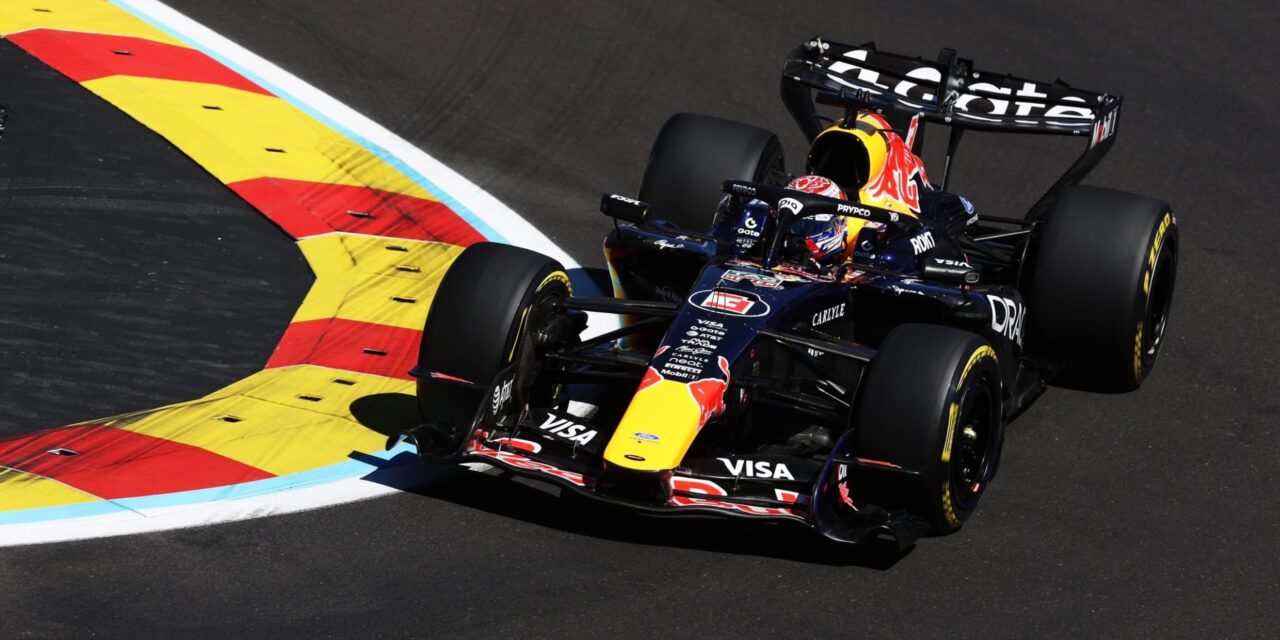
Red Bull team principal Laurent Mekies has acknowledged Max Verstappen’s concerns over a persistent “car degradation” problem with the RB22, admitting the team has made progress in understanding the issue but does not expect a complete solution during the 2026 Formula 1 season.
Verstappen has repeatedly complained about the behaviour of his Red Bull changing as sessions and races progress. The problem has often affected the rear of the car and became particularly noticeable during qualifying for the Italian Grand Prix at Monza, where Verstappen described the RB22 as “a car made of paper”.
The four-time world champion also revealed he has raised similar concerns internally for several years. That makes Red Bull’s continuing difficulties notable because Formula 1 introduced a major technical regulation overhaul for 2026, resulting in an entirely new generation of cars.
Laurent Mekies Agrees With Verstappen Over Red Bull Problem
Red Bull has spent considerable time trying to understand why performance drops away during sessions. Mekies accepts Verstappen’s assessment and says the problem affects both qualifying sessions and races.
The Red Bull boss stopped short of explaining the technical reasons behind the issue or revealing how the team plans to address the weakness.
“I don’t think we are going to explain what it is and how we are going to fix it. But I think Max is right [in saying] that there is an element of car performance degradation that is happening through a session and through a race.
“He’s also right in saying that it’s not a new issue. We are not sleeping on it. We have been trying to tackle that in different ways.
“Obviously, I consider it a complex issue. Otherwise, we would get to the bottom of it. But everyone is very constructive about it and we are trying to make small steps at the time to be able to finally get to the bottom of it.”
Red Bull Makes Progress After Difficult Monza Weekend
Monza provided Red Bull with further information about the RB22’s behaviour after Verstappen became frustrated during Saturday’s running. The team used those lessons at the following Spanish Grand Prix at Madring, where the same deterioration did not appear to affect the car to the same extent.
Verstappen enjoyed a competitive weekend in Madrid and finished second behind Mercedes driver Kimi Antonelli. The result followed his third-place finish at Monza and provided Red Bull with further evidence of its recent progress.
Mekies believes the team took positive steps in Spain, although he accepts Red Bull still lacks a complete understanding and does not yet have every required solution available on the current car.
“We had a couple of positive steps in that regard this weekend”, Mekies said.”It will never be the full picture, but we certainly have, through pain, made progress into our understanding. We don’t have all the solutions on the car yet, but I trust that we are in the right way. It will not be fast, so it’s something that will probably take us through next year.”
Some RB22 Weaknesses Will Require 2027 Changes
Mekies’ comments support Verstappen’s previous suggestion that Red Bull will need to wait until 2027 to fully address some of the weaknesses identified this season.
There are limits to how extensively Red Bull is able to modify the RB22 during the remaining races. Formula 1’s budget cap restricts spending, while development resources are increasingly moving towards the team’s 2027 challenger.
Some of the required improvements also appear to involve areas of the car where substantial changes during the current season are impractical. Red Bull therefore needs to balance smaller improvements to the RB22 against the opportunity to address the underlying characteristics through next year’s design.
That means Verstappen and Red Bull face the possibility of the same performance deterioration returning during the remaining races of 2026.
Red Bull Says Performance Loss Costs “Serious Lap Time”
Mekies would not reveal the precise technical cause of the problem, but he acknowledged the performance loss is significant enough to demand continued attention.
“Look, I’m not going to give any more details here. But as I said, it’s true that there are some aspects of the car performance that sometimes don’t stay at the optimum level. And that’s serious lap time.
“So, it’s something we [need to get on top of]. There is no doubt that we have everyone trying to improve that for the future.”
Red Bull’s challenge now involves limiting the problem during the final part of 2026 while ensuring the same weakness does not carry into its next car.
Recent weekends have offered some encouragement. Verstappen returned to the podium at Monza before taking second in Madrid, where Red Bull finished close to the front throughout the weekend. Mekies also described the team’s Spanish performance as confirmation of the pace shown in Italy.
Verstappen Still Searching for 2026 Victory
With Mercedes dominating much of the 2026 season and Antonelli leading the drivers’ standings, Verstappen has already accepted that he is no longer a realistic factor in the championship battle.
His remaining target is a Grand Prix victory before the season ends. Verstappen has won at least one race in every season since joining Red Bull during the 2016 campaign, making his current winless run unusual by his standards.
If Verstappen reaches the end of 2026 without a victory, this would become his first winless Formula 1 season since his rookie campaign with Toro Rosso in 2015.
Baku now provides his next opportunity. Verstappen enters the Azerbaijan Grand Prix following consecutive podium finishes at Monza and Madring, but Red Bull knows the RB22’s underlying performance problem has not disappeared.
The team has improved its understanding and found some short-term gains, yet Mekies expects the search for a complete solution to extend into 2027. For the remainder of this season, Red Bull’s task is to manage the weakness while giving Verstappen enough performance to fight for the victory still missing from his 2026 campaign.