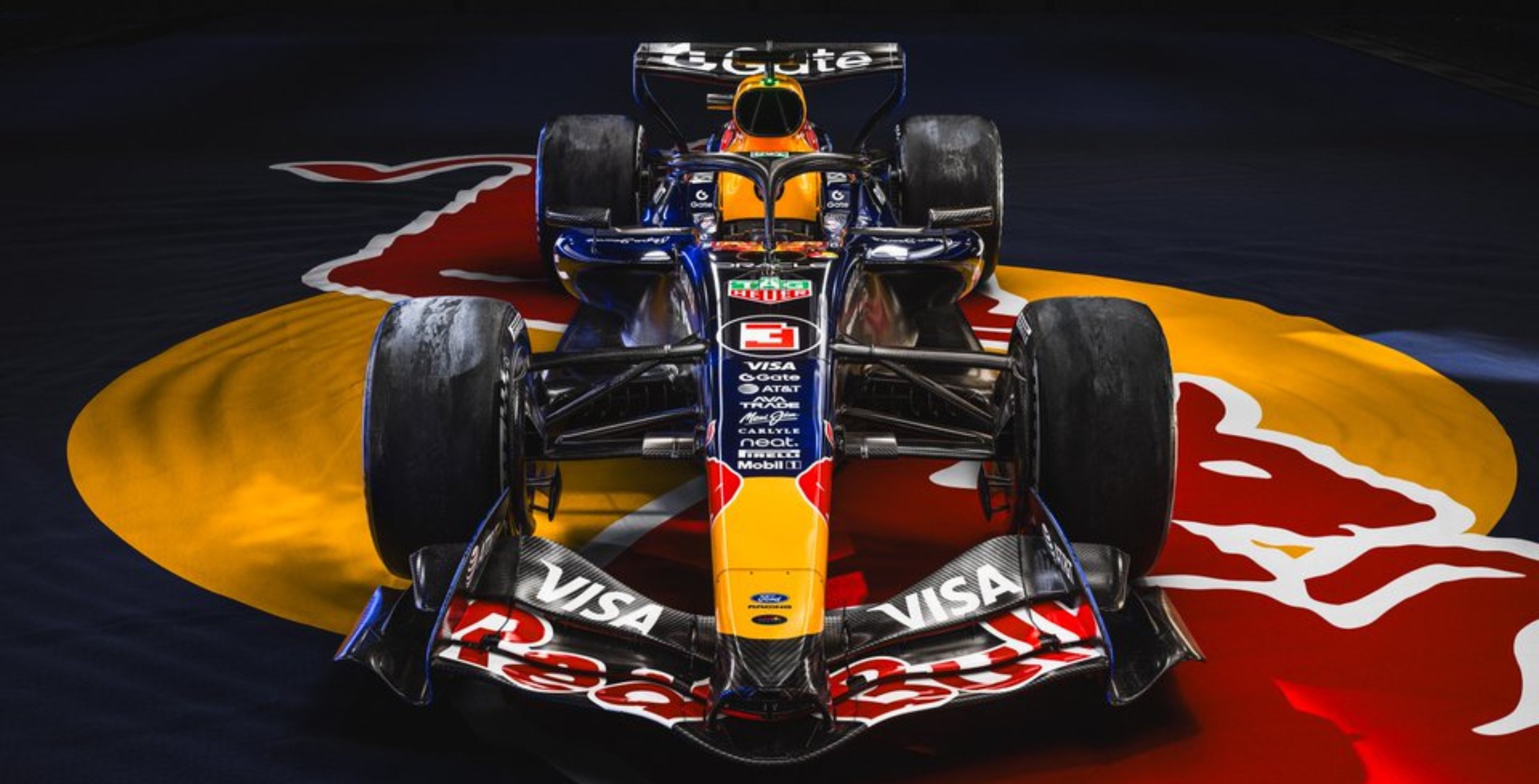
Red Bull Racing has revealed its 2026 Formula 1 livery, marking a major moment in the team’s history as it prepares to run its first car powered by an in house power unit developed in partnership with Ford.
The launch took place in Detroit, the home city of Red Bull’s new power unit partner, and featured a show car wearing a refreshed look after several seasons of only minor visual changes. While the overall Red Bull identity remains familiar, the 2026 design introduces clear updates that signal a new era for the team.
A New Look for a New Era
The RB22, which will be raced by four time world champion Max Verstappen and new team mate Isack Hadjar, adopts a blue and black colour scheme. A lighter shade of blue has been added using a jacquard style pattern, giving the car more texture and depth. Red Bull has also returned to a glossy finish after several years of using a matte surface, making the car stand out more strongly under the lights.
The changes are deliberate rather than radical. Red Bull has chosen evolution over reinvention, aligning a refined visual identity with the technical reset coming in 2026.
A Bold Reveal in True Red Bull Style
True to the brand’s reputation for spectacle, Red Bull opted for an unconventional reveal. The cover was torn off the car by stunt pilot Martin Sonka, who descended from the sky in his plane to unveil the livery. The moment underlined Red Bull’s confidence and its continued desire to do things differently from its rivals.
The reveal was not just about colour and design. It was a statement of intent as the team enters the most complex technical challenge it has ever faced.
The Power Unit Challenge
Following the end of its long running partnership with Honda, which has now moved to Aston Martin, Red Bull has taken on the task of building its own power units for the first time. The work is being carried out at Red Bull Powertrains, and it represents the biggest technical undertaking in the team’s 20 year Formula 1 history.
Red Bull Powertrains chief Ben Hodgkinson spoke openly about the scale of the challenge and the opportunity it presented.
“I loved the idea of it being a blank sheet of paper, not just the power unit but the whole company, so we could custom build it to what we knew the regulations were going to be, which was a pretty cool opportunity,” said Hodgkinson.
Building From Scratch
The ambition of the project quickly became clear as Red Bull expanded its operation at speed. Creating an entirely new power unit division meant recruiting hundreds of people and establishing new processes in a very short time.
“The gravity of what that meant took a while to really sink in and trying to find what’s turned into 700 people in a short space of time has been really challenging,” Hodgkinson explained.
Despite the difficulty, the project has aligned closely with Red Bull’s identity.
“If you create a really bold and audacious project it only really attracts bold and audacious people, so those people fit the Red Bull culture absolutely like a glove. It’s brilliant for the rate of innovation, so it’s been an exciting, pretty intense four years.”
Looking Ahead to 2026
The 2026 livery reveal is about more than aesthetics. It represents a clean break from the past and the beginning of Red Bull’s next phase. With a new driver pairing dynamic, a new power unit partner, and a completely new engine built in house, the team enters the regulation reset with confidence and ambition.
The RB22’s colours may be familiar, but the story behind the car is entirely new. For Red Bull, 2026 is not just another season. It is the ultimate test of whether its boldest project yet can deliver at the very front of Formula 1.