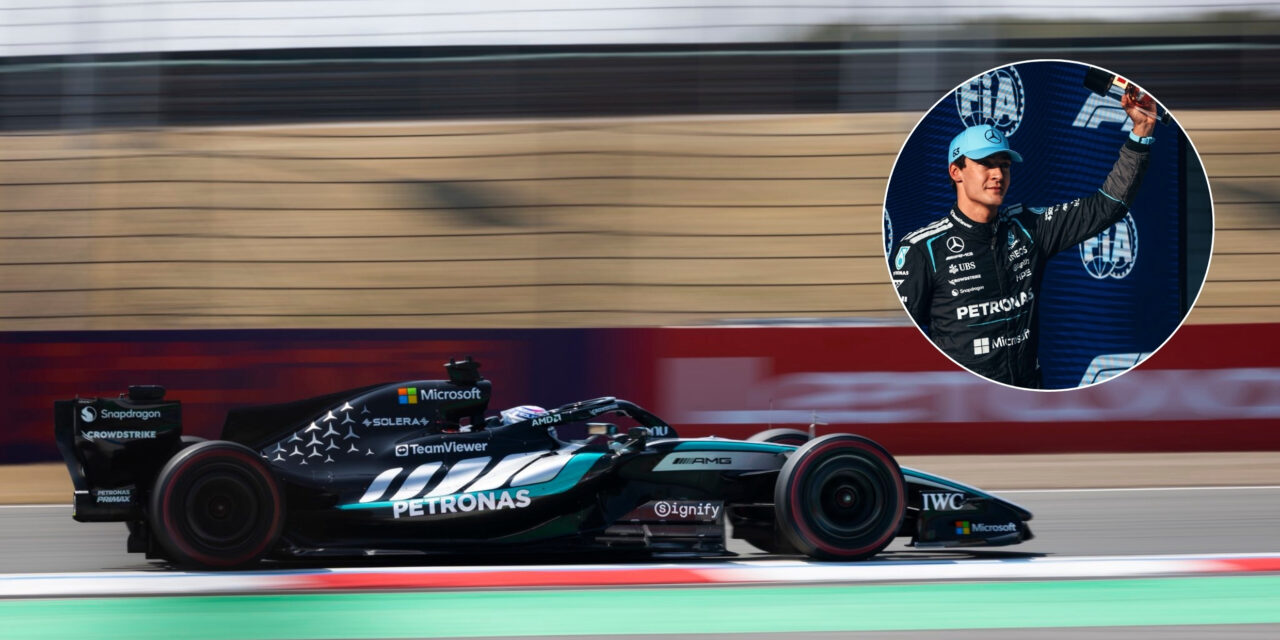
Mercedes continued its dominant start to the 2026 Formula 1 season by securing another front row lockout during sprint qualifying at the Chinese Grand Prix.
George Russell once again led the way for the Silver Arrows, finishing more than half a second clear of the nearest non Mercedes powered rival, the McLaren of Lando Norris. The result followed Mercedes’ commanding one two finish in the season opening Australian Grand Prix and reinforced the team’s early advantage under the new regulations.
Although Mercedes had been expected to fight near the front this season, the scale of its advantage has still surprised some within the paddock. McLaren driver Oscar Piastri described the team’s pace so far as “impressive”.
Russell and team mate Kimi Antonelli locked out the front row for the sprint race in Shanghai. Antonelli had briefly been under investigation for a potential impeding incident involving Norris, but the stewards decided to take no further action after Norris confirmed he was not on a push lap.
Why were Mercedes so dominant
Mercedes CEO and team principal Toto Wolff explained where he believes the team currently holds its performance advantage.
“I’m really satisfied, or we can be satisfied with how it went. There’s a healthy gap to the others. But for me, sprint qualifying and also the sprint race feel a bit like the small race of the weekend,” Wolff told Sky.
“Tomorrow is the real qualifying and Sunday is the grand prix. If we could carry this performance forward there, that would of course be great.
“I think our big advantage here is mainly in the corners. You can see it in certain cases: [Pierre] Gasly, for example, was the fastest on the straights, but our advantage comes in the corners.”
Analysis of the data from sprint qualifying highlights the strengths of the three Mercedes powered teams that reached Q3: Mercedes, McLaren and Alpine. Each car demonstrated different strengths across the Shanghai circuit.
Mercedes sacrificed some top speed at the end of the straights by beginning its energy deployment strategy earlier, but gained time through higher minimum cornering speeds. This allowed the drivers to carry more momentum through corners and accelerate earlier on exit.
The advantage was particularly visible through Turn 6 and Turn 11, where the Mercedes cars carried roughly 5 km/h more speed than the Alpine of Pierre Gasly.
McLaren showed strong performance through the opening complex of Turns 1 to 3, with Norris even gaining a small time advantage in that section. However, the MCL40 struggled to match Mercedes on the straights, reaching around 7 km/h less top speed on the back straight.
This balance between corner speed and straight line performance appears to be one of the reasons behind Mercedes’ early dominance.
Wolff also suggested that Mercedes’ early focus on its 2026 car may be paying dividends now that the new regulations are in place.
“We’ve seen in the past teams that have said that we concentrate everything into the next year and then it failed. I remember the BMW days where they could have competed for a championship, and then came around with a double diffuser the following year and they left.
“We put a lot of effort into the into the ’26 car, maybe a bit earlier than some of the others. But I’m really happy the integration of power unit and chassis works well.
“You can see Ferrari, which is an integrated structure and Audi also as a works team that has certain advantages because you learn early. But then what I’m really pleased with is how the car drives.
“I mean, you see the onboard, the car’s on rails, and most of the lap time gain that we have is in the corners.”
With Mercedes already showing a clear advantage in both Australia and China, the rest of the grid faces an early challenge to close the gap as the 2026 season continues.