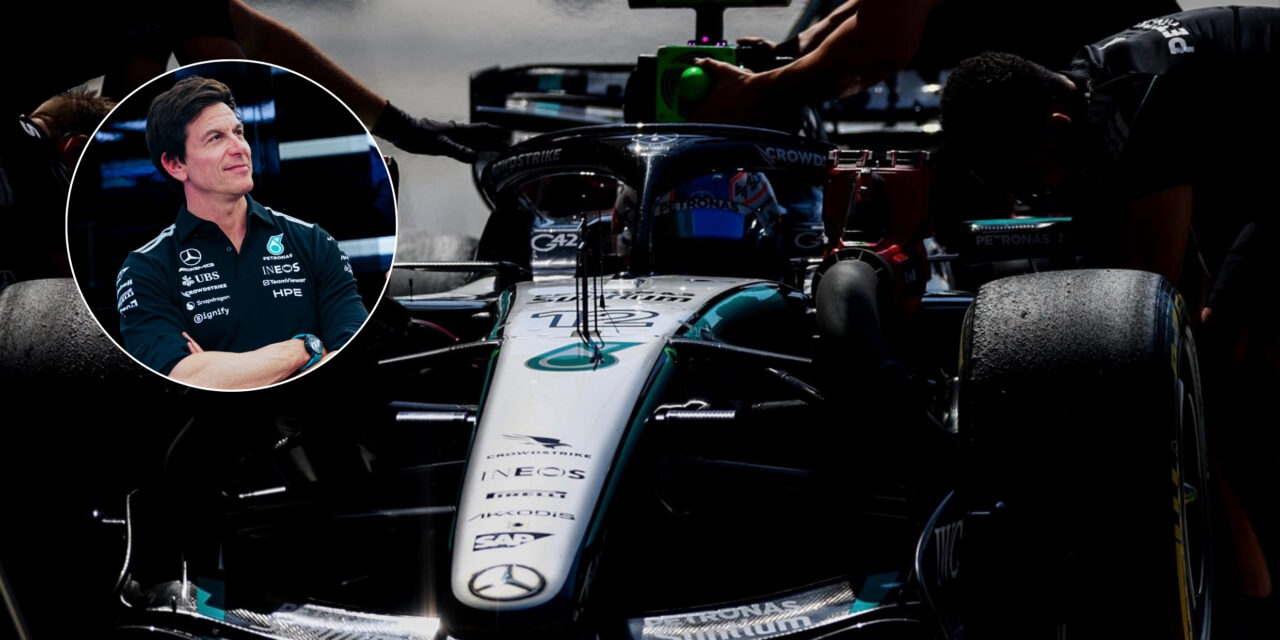
Mercedes team principal Toto Wolff has doubled down on his defence of the team’s 2026 power unit, labelling suggestions that it is illegal as “utter bulls**t” and describing the entire compression ratio saga as “a storm in a teacup”.
Speaking to several media outlets during Bahrain pre-season testing, Wolff addressed the growing controversy surrounding the way Mercedes has interpreted Formula 1’s revised 2026 engine regulations.
Under the new rules, the compression ratio was reduced from 18:1 to 16:1. However, Article C5.4.3 specifies that the ratio is measured via a static test at ambient temperature. It is understood that Mercedes found a way to remain compliant under that test while running a higher ratio when the engine is operating on track, before returning to the mandated limit.
That interpretation has angered rival manufacturers. On Wednesday, the FIA confirmed that an e-vote will be held among the seven members of the Power Unit Advisory Committee, the five power unit manufacturers, the FIA and Formula One Management, to decide whether to revise the compression ratio measurement procedure, potentially introducing a new operational temperature test from August 1.
Previously, Wolff insisted the advantage amounted to just 2–3bhp, although Red Bull world champion Max Verstappen suggested “you definitely have to add a zero to that”.
Despite the noise, Wolff sought to downplay the situation.
When asked by Motorsport.com about the issue in Bahrain, he replied: “We said it all along that this looks like a storm in a teacup, the whole thing.
“Numbers were coming up that were, you know, if these numbers would have been true, absolutely understand why somebody would fight it. But eventually, it’s not worth the fight.
“It doesn’t change anything for us, whether we stay like this or whether we change to the new regulations, and that’s been a process. But we also want to be good citizens in the sport because it doesn’t make a big difference.
“We then changed opinion. Philosophically, you can disagree with it, because I believe regs are there to be made and you keep the FIA close to you – and that’s how it should be.
“But, if you have four other PU [manufacturers] that are putting immense pressure on the FIA at a certain stage, what choice do we have [other] than not to play? We were pretty comfortable in even having a protest going on Friday in Melbourne.
“Is this what we want?”
While Wolff has indicated Mercedes would “take it on the chin” if a rule change is enforced, he was far more combative when asked whether Formula 1’s governance structure had been weaponised and whether the sport remains a meritocracy.
“Formula 1 is a meritocracy, and we don’t want any balance of performance,” he said. “I think that philosophically we need to stick to it. You’ve developed the component to the regulations, and that’s been confirmed.
“Then everybody else gangs up and says it’s illegal, the regulator is being put under pressure.
“Is that how it should go? Philosophically, I disagree, but that’s what has happened the last 50 years in Formula 1.
“This time, we were on the receiving end. I guess next time, maybe, we will be ganging up against somebody else because we believe it’s not right.”
Wolff also stressed that any revised testing method must ensure compliance in both cold and hot conditions.
“I think the way it’s being done now, it needs to be compliant to the regulations when it’s cold and when it’s hot,” he said.
“It doesn’t give anybody an advantage, because I think the attempt was from the other guys to have it only measured so they could actually have it cold outside of the regulation.”
Beyond the compression ratio row, Mercedes has also faced speculation regarding its Petronas sustainable fuel certification ahead of the Australian Grand Prix.
Wolff dismissed that narrative just as forcefully.
“This is another of these stories,” he said.
“We were told compression ratio is something that we were illegal, which is total bulls**t, utter bulls**t. And now the next story comes up that our fuel is illegal.
“I don’t know where that comes from and it starts spinning again. Maybe tomorrow we’ll invent something else.”
With an e-vote looming and Mercedes widely tipped as a title contender under the new regulations, the political battle off track appears almost as intense as the competitive one shaping up for 2026.