The Mexico Grand Prix has always presented Formula 1 teams with an unusual technical challenge, but the new 2026 regulations have made racing at the Autodromo Hermanos Rodriguez even more demanding.
Located 2,286 metres above sea level, the Mexico City circuit sits comfortably higher than any other venue on the F1 calendar.
The altitude creates thinner air, placing extra demands on both the power unit and aerodynamic package. Those challenges have taken another step in 2026 following the removal of the MGU-H and introduction of active aerodynamics.
Turbo lag, engine performance, reduced downforce and a newly resurfaced track will all play a part as teams attempt to understand how the new generation of F1 cars behaves in Mexico.
Why Mexico’s Altitude Puts F1 Engines Under Pressure
Mexico City’s thinner air creates an immediate problem for Formula 1 power units.
At higher altitude, fewer oxygen molecules are present in each cubic metre of air. The turbo therefore needs to work harder to supply the engine with the required oxygen.
That requires considerably higher turbo speeds to produce the desired boost pressure and airflow.
Performance is only one concern. Reliability also enters the equation because the turbo operates under greater stress and at higher temperatures than under more conventional conditions.
This challenge is one reason George Russell identified Ferrari as a major threat heading into the weekend.
Ferrari is widely understood to use a smaller turbo than several of its rivals. A smaller turbine carries less mass and inertia, helping the turbo spool up faster when the driver applies the throttle.
That characteristic should help reduce turbo lag, an area expected to play a major role throughout the Mexico weekend.
Removal of MGU-H Creates New Problem
The 2026 regulations have made the turbo challenge more difficult.
Last year’s power units used the MGU-H to help manage turbo response. The system has now disappeared under the new regulations, leaving manufacturers with fewer tools to combat lag.
Honda chief engineer Shintaro Orihara explained why the difference matters.
“Last year, we had the MGU-H, so we had some support from MGU-H, but this year we don’t have the MGU-H anymore, so that makes it quite challenging,” Honda’s chief engineer Shintaro Orihara said when asked about the challenges by Motorsport.com.
“For example, even just in idle conditions, we had MGU-H support to get enough boost pressure, but this year we don’t have any support even in idle conditions. That is a big difference from last year and therefore turbo lag is the most interesting and important topic at this track. I think that is not only the case for Honda, but for all manufacturers. They will all struggle with turbo lag at this track.”
Every power unit manufacturer therefore faces a significant test.
Drivers need predictable power delivery when accelerating out of Mexico’s corners, while manufacturers need to find a compromise between response, performance and reliability.
Engine Power Could Also Be Affected
Turbo lag is not the only power unit concern.
Manufacturers also need to establish whether their turbochargers are capable of delivering the required boost while remaining within their operational limits.
If the turbo reaches its maximum permitted operating speed before producing enough boost pressure, manufacturers face the possibility of restricting how aggressively they run the internal combustion engine.
Honda has completed extensive dyno testing ahead of the weekend and does not currently expect a major loss of performance.
Friday practice will provide the first proper confirmation.
“Normally in Mexico, the turbo charger speed is quite high to get enough airflow. We need to check, but we may have some restrictions on the engine operation condition in the worst case. At the moment, we have done a lot of dyno testing and we believe there is almost no impact, or only a small impact on our engine operation condition, but we need to check these things in free practice,” Orihara explained.
The engine’s operating condition will determine how much of its maximum potential manufacturers are able to access at altitude.
Orihara explained the limitation further.
“Every turbo charger has some limitations in terms of its operational speed. If we hit that [maximum] operational speed and we still can’t provide enough boost pressure, then the operation point of the engine will be limited. At the moment, we don’t have any concern, but we need to check this in free practice as well,” Orihara continued.
Honda Faces Major Mexico Test
Honda will attract particular attention throughout practice following previous problems with turbo lag.
The manufacturer struggled with the issue in Singapore despite using its second ADUO token of the season in Madrid to introduce a new turbocharger aimed at improving driveability.
Honda responded with further countermeasures ahead of Austin.
Those changes produced encouraging results at the United States Grand Prix, but Mexico’s altitude presents a much tougher examination of the revised package.
“So in Austin, we have brought some countermeasures for turbo lag, and we have confirmed the effect of those on the lag. That was quite positive for us before coming to here,” he said.
“And also in Sakura, our facility in Japan, they are still working hard to optimise turbo lag. We have a lot of options to improve the lag. One option is our harvesting strategy with the MGU-K, so in Sakura, they are still working hard to improve the turbo lag situation.
“But even after we saw some positive signs in Austin, this is still completely different for us [with the altitude]. So it’s quite important to see how our car behaves in free practice.”
Honda therefore enters Friday with encouraging data from Austin but no guarantee those improvements will translate to Mexico City’s conditions.
Active Aerodynamics Changes Traditional Mexico Setup
Power units only represent half of the challenge.
Mexico has traditionally produced unusual aerodynamic setups because teams need to compensate for the reduced air density.
Teams have often brought wing levels similar to those used around Monaco. Despite running large wings, the thin air means the cars generate downforce levels closer to what much smaller wings would produce at a circuit such as Monza.
The drag penalty associated with running large wings also decreases because of the thinner air.
Active aerodynamics changes the equation in 2026.
Teams no longer have the same freedom to select dramatically different wing configurations for individual circuits, according to Max Verstappen.
“Here is a lot less grip. With the altitude, we normally have the wings to compensate a little bit for that, but now you basically just run one wing,” Max Verstappen said.
That means drivers face the prospect of having even less downforce around the Autodromo Hermanos Rodriguez.
Isack Hadjar Predicts ‘Slippery as Hell’ Mexico Weekend
The current cars already produce significantly less downforce than their ground-effect predecessors.
Combine that with Mexico City’s altitude and the restrictions created by active aerodynamics, and grip should become one of the defining issues of the weekend.
Red Bull’s Isack Hadjar has already predicted the cars will feel “slippery as hell”.
The issue follows a different problem caused by active aerodynamics in Austin.
There, cars rose on the straights, giving teams more protection against excessive skid block wear. Engineers were therefore able to run the cars lower through the corners.
Mexico presents another consequence of the same technology.
Rather than focusing on bumps and ride height, teams need to manage a reduction in available aerodynamic grip.
New Mexico Asphalt Adds Another Unknown
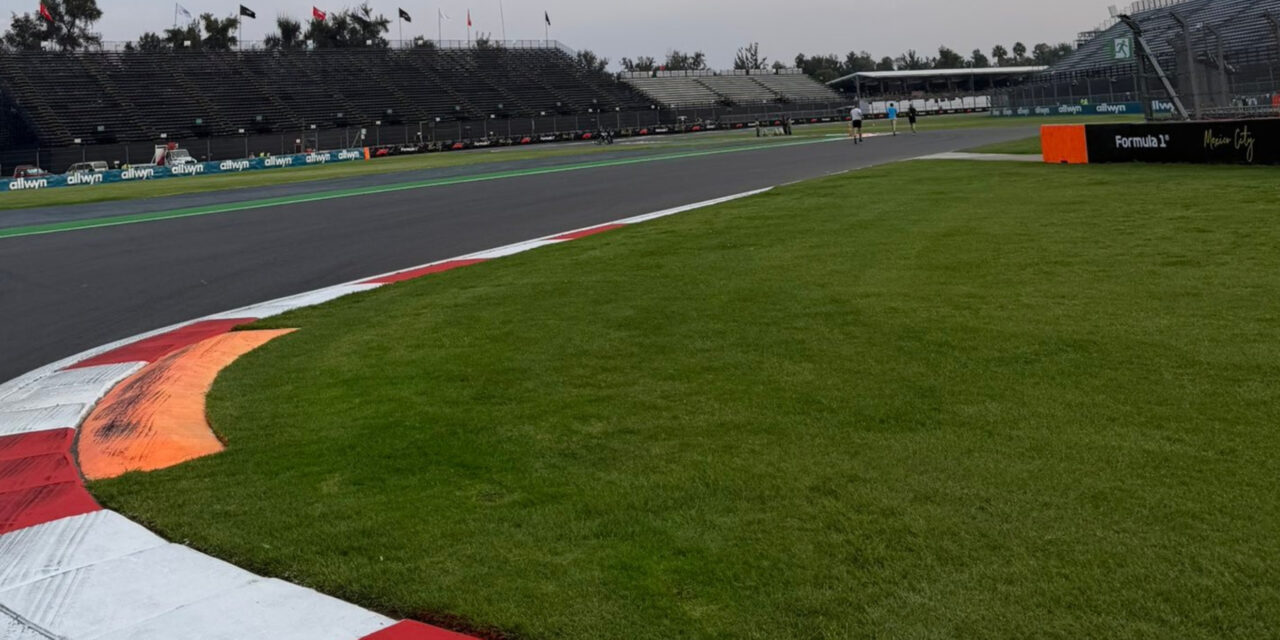
The Autodromo Hermanos Rodriguez has another variable for teams to understand this weekend following resurfacing work.
New asphalt should offer greater grip and help compensate for some of the downforce lost through the thinner air.
Yet teams do not have complete real-world data on how the new surface will behave.
Aston Martin chief trackside officer Mike Krack expects the resurfacing to help, although he believes Friday practice will provide important answers.
“Normally when they resurface it, the track is smooth and the grip is higher, which should help,” Krack said.
“Obviously we lose 20-25% of density, which is the same equivalent in load. Whatever you can gain in terms of tyre-road interaction will help you. I think there will be a step in the right direction with more grip.
“Now it’s often very dirty here in the first session, so the track will improve quite a lot. We are curious to see how it will change and if we can have better grip from the beginning.”
Track evolution should therefore become another factor teams need to monitor closely.
If the new asphalt provides the expected increase in mechanical grip, drivers will receive some relief from the reduced aerodynamic load.
Teams will still need to establish how quickly the surface evolves and how tyres respond across longer runs.
Mexico FP1 and FP2 Take on Extra Importance
The combination of new power units, active aerodynamics, reduced downforce and fresh asphalt means simulation work only provides part of the answer before the cars reach the circuit.
Manufacturers need to confirm their turbo performance under real conditions.
Honda needs to establish whether its Austin countermeasures remain effective at much higher altitude.
Teams also need to understand the grip provided by the new asphalt and how the active aerodynamic cars respond to Mexico’s thin air.
Ferrari’s smaller turbo has already attracted attention, while Mercedes, Red Bull and the other manufacturers face their own compromises between performance and reliability.
Mexico has always forced Formula 1 engineers to approach a race weekend differently.
The 2026 regulations have added several new problems to solve, making Friday practice one of the most important technical tests of the season.